

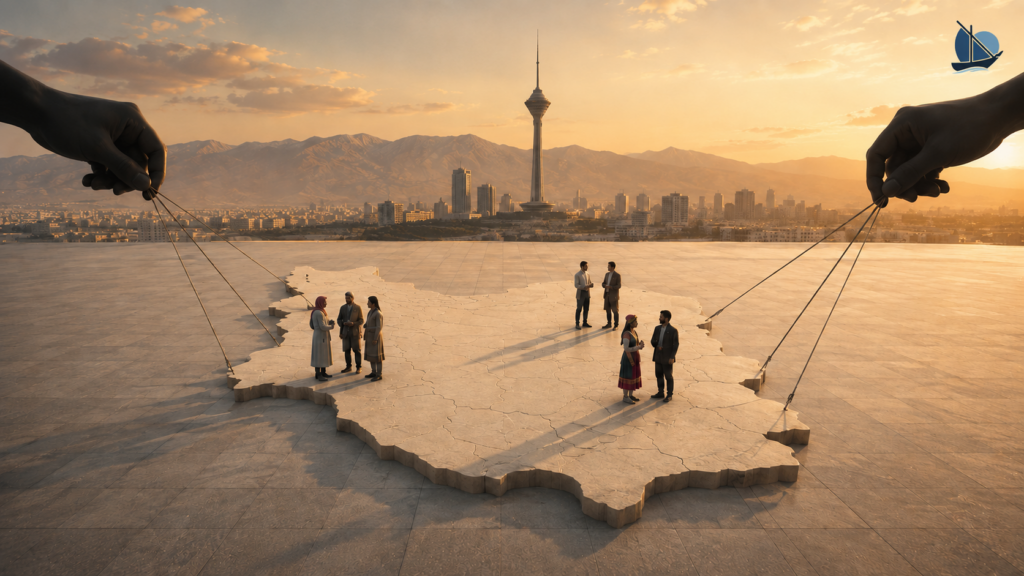
The United States–Israeli war against Iran was accompanied by assumptions in some external circles that military strikes and economic pressure could transform Iran’s ethnic and linguistic communities into internal fronts, ultimately contributing to the overthrow of the ruling system in Tehran. The underlying expectation was that Arabs, Kurds, Azerbaijanis and Baluch would constitute vulnerabilities that could be mobilised against the state. The evidence available so far, however, does not indicate that these communities have formed a broad, organised and collective alignment in support of an external power or a separatist project.
This does not mean that these groups lack grievances, protest movements or opposition, particularly in relation to language rights, political representation, development, justice and the security policies of the central state in Tehran. The central flaw in the external calculation was the assumption that these grievances would automatically translate into protest mobilisation. This approach treated ethnic identity as if it were a political programme in itself and assumed that war would expand people’s capacity to organise and act.
It is not enough to ask why an internal front failed to emerge. It is also necessary to examine why Iran’s social diversity was misread as a military map ready for exploitation. Arabs, Kurds, Azerbaijanis and Baluch are not politically homogeneous blocs. They are complex societies shaped by class, sectarian and local divisions that vary across generations. Attitudes towards the state, the war, external powers and armed action also differ substantially within each community.
The “failure of the bet” does not mean that opposition has disappeared or that underlying tensions have been resolved. It refers instead to the absence of independent evidence during the war that these communities developed into a broad and organised internal front. This distinction separates the existence of a social grievance from the capacity to transform it into organised political action. In political sociology, a grievance becomes collective mobilisation only when it is supported by local organisation, resources, political opportunity and an intermediary capable of connecting demands to action. Identity may provide a language through which claims are articulated, but it does not by itself produce a political movement.
Limits of the Evidence: Why Caution Is Necessary
Iran’s demographic censuses do not provide direct data on ethnic or linguistic affiliation, and there are no reliable surveys covering these communities comprehensively. The strength of the available evidence also varies significantly from one case to another.
In the Kurdish case, Reuters reported in March 2026 that informed sources had discussed contacts and plans involving Iranian Kurdish factions based in Iraq. Reuters also stated that it had been unable to verify either the mobilisation of fighters or the implementation of the proposed attack. In the cases of Arabs, Azerbaijanis and Baluch, independent sources provide no comparable operational evidence of a large-scale external plan that secured meaningful social support inside Iran. This article therefore examines a general hypothesis. It does not claim that the scale or mechanisms of the external bet were identical across all four cases.
A recent interview with the Iranian foreign minister on 19 July adds an account from an official party to the war. Abbas Araghchi stated that President Trump contacted leaders of the Kurdistan Region of Iraq on the “fourth day” of the war. Araghchi added that he contacted Masoud Barzani, Bafel Talabani, Mohammed Shia al-Sudani and Hakan Fidan on the same day, warning against any movement originating from the region. An Iranian government website summarised the account as follows: Trump contacted the leadership of the Kurdistan Region of Iraq, after which Araghchi contacted regional officials, the Iraqi prime minister and the Turkish foreign minister, warning them against “movement and conspiracy”.
From late February through March, the Kurdish case provided the clearest example of the external calculation. It involved factions based abroad, cross-border plans and a declared need for air support and advanced weapons. The conflict then continued from spring into early summer, while independent access to information remained limited. In July, field reports documented the effects of the war on electricity, water and transport infrastructure, together with the fear that had become a direct factor in the calculations of local residents, particularly in the south.
This sequence does not prove that bombardment “produced” patriotism or extinguished protest. It does, however, help explain why wartime grievances did not automatically generate organisational capacity. This is an analytical inference rather than a definitive conclusion. During war, resources, time and social networks may be consumed by survival, income security and family protection more than by any other activity.
In the most recent field-based indication available, Reuters interviewed more than twenty residents of southern Iran, including government critics and former participants in protests. The interviews did not record support for renewed protest during the bombardment. These were limited interviews rather than a national opinion poll or a representative sample of ethnic communities. They nevertheless undermine the assumption that military harm automatically triggers an uprising in peripheral regions.
This is not only a matter of individual psychology. It is also a question of resources and opportunities. War may narrow the space for public action, increase the cost of coordination and push local networks to redirect their energy towards survival rather than protest.
Between the Official Narrative and Persistent Grievances
Article 15 of the Iranian Constitution establishes Persian as the language of the state and of official education. It also permits the use of local and ethnic languages in the press and media, as well as the teaching of their literature. Article 19 provides for equality among citizens regardless of ethnicity or language, while Article 48 prohibits discrimination among provinces and regions in the exploitation of natural resources, the use of national revenues and the distribution of economic activity.
In its report to the United Nations Committee on the Elimination of Racial Discrimination, the Iranian government argued that ethnic groups are socially integrated rather than isolated. It stated that intermarriage and long-term social interaction had produced a shared national identity. It also affirmed the existence of legal equality and denied the presence of racial discrimination.
By contrast, the Office of the United Nations High Commissioner for Human Rights stated that repression during the 2022 protests affected ethnic and religious minorities disproportionately. It specifically identified Kurds, Baluch, Azerbaijanis and Ahwazi Arabs. These two accounts do not necessarily cancel each other out. Social integration and national ties can coexist with genuine grievances concerning language, services, representation and justice.
From a sociological perspective, ethnic belonging does not correspond automatically to political loyalty. National and local identities may coexist within both individuals and communities, while their relative importance may shift according to social and political circumstances.
Khuzestan, also known as Ahwaz, combines oil resources, border geography, demographic diversity and the historical memory of the Iran–Iraq War. These factors make it analytically misleading to reduce its Arab population to an “external card”. Demands related to water, the environment, employment and public services are real and well documented. They do not justify treating the Arabs of Khuzestan solely through the prism of external intervention.
A survey study published in an Iranian academic journal concluded that the Iran–Iraq War strengthened the convergence of ethnic and national identity among the sample of Khuzestani Arabs it examined. The findings of a single study should not be generalised to all Ahwazi Arabs or used to deny the existence of discrimination. The study nevertheless offers a useful scholarly reminder that Arab identity does not automatically conflict with a sense of Iranian belonging.
Interviews published in July provided an additional but limited indication rather than a representative sample of Khuzestan’s Arab population. Reuters spoke with residents of southern Iran, some of whom were critical of the government and blamed external strikes for worsening service disruptions and public fear. The report recorded no new wave of protest.
This evidence is insufficient to determine the attitudes of all Arabs in Khuzestan. It does, however, weaken the assumption that military strikes automatically generate renewed protest in the south. The more accurate conclusion is that the expectation that the attacks would produce broad popular support for an external project was not realised. At the same time, it would be equally inaccurate to claim that the Arabs of Khuzestan constitute a uniformly pro-state bloc or that their grievances have been resolved.
The Kurds: The Most Well-Documented Case
The Kurdish case provides the closest opportunity to test the hypothesis directly. It also attracted the greatest political and media attention because the presence of Iranian Kurdish parties and factions in the Kurdistan Region of Iraq created the impression that an effective and consequential border front could be activated.
Kurdish factions possess light weapons, but any major operation would have required United States and Israeli air support. At the same time, the leadership of the Kurdistan Region of Iraq denied any intention to send fighters or participate in the war. These circumstances demonstrate that the existence of opposition organisations does not necessarily confer domestic social legitimacy or an independent capacity to alter the balance of power.
Dependence on external military support increases a faction’s vulnerability to attack. It also forces local communities to weigh legitimate political demands against the risk that their cities could be turned into a theatre of war. This cost becomes more significant in light of the United Nations mission’s documentation of the executions of Kurdish men in 2025 on charges of collaboration with Israel. The mission stated that these proceedings lacked fair-trial guarantees. This does not justify repression, but it helps explain the climate of fear within which activists and anyone accused of links to foreign powers must operate.
Language Is Not a Geopolitical Mandate
External calculations concerning Iran’s Azerbaijani population are based largely on its linguistic and cultural proximity to Azerbaijan. A closer examination of Iranian Azerbaijani society, however, reveals a more complex picture. Persian is the language of state institutions and education, while Azerbaijani remains deeply rooted in family life and in the cities of north-western Iran.
Article 15 of the Constitution is permissive rather than mandatory. It does not require the establishment of a bilingual education programme. The demand for language rights and cultural recognition therefore remains a domestic political issue. It does not in itself constitute evidence of political loyalty to Baku or of separatist aspirations.
The course of the war highlighted the dangers associated with the border rather than reinforcing the idea of a transnational ethnic extension. In March, Azerbaijan evacuated staff from its embassy in Tehran and its consulate in Tabriz after accusing Iran of sending drones towards Nakhchivan. Tehran denied the allegation.
None of the available sources presents a documented operational plan comparable to the Kurdish case that was based on social support among Azerbaijanis inside Iran. Nor does the available evidence provide a direct indication of a broadly shared Azerbaijani social position towards the war. Linguistic affinity and tensions between Baku and Tehran should therefore not be treated as sufficient grounds for assuming the existence of a geopolitical alignment within Iran.
In Sistan and Baluchestan, ethnicity intersects with a predominantly Sunni population, border geography and economic deprivation. The International Crisis Group describes the region as suffering from social and economic deficits, environmental scarcity, political exclusion and recurring violence. These conditions help explain the potential for protest, but they do not reduce the population to an extension of any armed actor.
Before the war, several organisations documented protests in Zahedan and demands relating to living conditions and political rights. They also reported that a Baluch coalition had affirmed its decision not to intervene directly in the January protests because it feared giving the authorities a pretext for further repression.
During the war, media reports from Konarak recorded limited testimonies expressing fears about explosions, extreme heat and disruptions to electricity and water supplies. These accounts do not demonstrate the absence of opposition. They do, however, further weaken the assumption that bombardment creates additional organisational capacity. Such an assumption remains both insufficiently supported and premature.
Why Did the External Bet Fail to Produce an Internal Front?
First, identity is not a political programme. A citizen may demand education in their own language, equitable distribution of resources or an end to repression while simultaneously rejecting any attempt to associate those demands with foreign bombardment or a project to partition the country.
Second, a movement requires a credible intermediary between grievance and action. Exiled factions and external rhetoric are insufficient. Effective mobilisation requires local organisation, diverse representation, a plan to protect civilians and a convincing political vision for the period after the fighting. In the Kurdish case, dependence on foreign support and the absence of regional guarantees revealed significant deficiencies in these conditions.
Third, war changes priorities but does not determine loyalties. Field testimonies indicate that the burdens of daily life and levels of fear increased substantially. It is reasonable to infer that these conditions may weaken mobilisation against the state. This remains a probable inference rather than a universal social law applicable to every region and every period.
Fourth, association with external powers carries a high cost. When the state treats alleged links to a hostile actor as a matter of national security, the risks associated with public political activity increase, particularly in border regions.
Fifth, the available knowledge remains incomplete. There is no recent ethnic census, no comprehensive wartime survey and no unrestricted access to the country for United Nations mechanisms.
The evidence available so far does not support an interpretation that treats Arabs, Kurds, Azerbaijanis and Baluch as buttons that external powers can simply press. This conclusion does not deny the existence of deep grievances, protest movements or legitimate cultural and political demands. It rejects the assumption that these grievances constitute advance evidence of support for war or separatism.
The war that has continued since February has not produced a broad internal ethnic front. It has also failed to resolve the tensions that preceded it. Distinguishing between these two realities is essential to a more accurate sociological analysis. Iran’s non-Persian national communities are neither readily available instruments for external adversaries nor silent, homogeneous populations aligned with the government in Tehran.
