

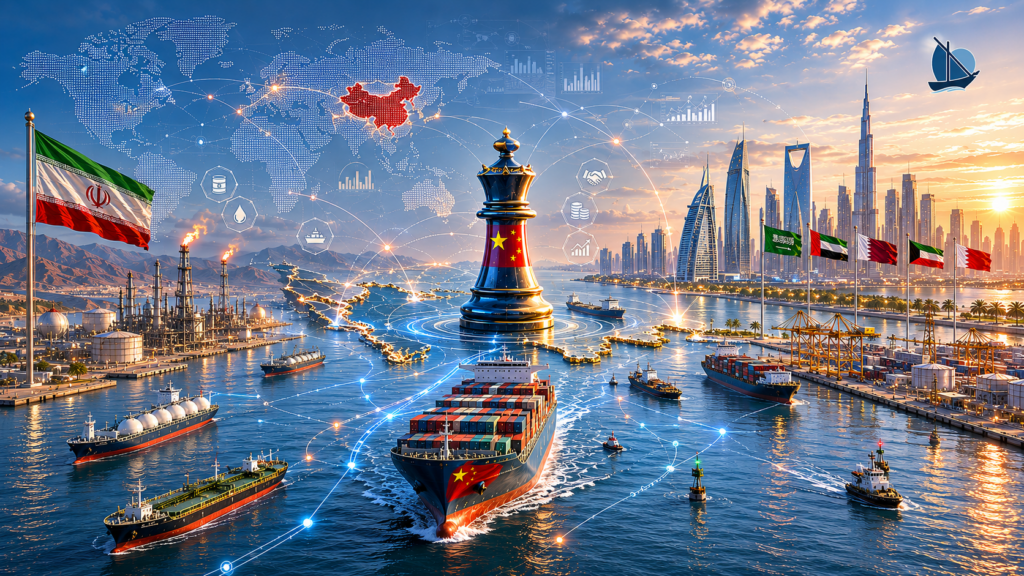
Can China’s relationship with the Gulf states and Iran be described as an equilateral triangle? The answer is not straightforward without understanding the underlying logic that shapes Beijing’s view of the Gulf region. China appears to operate according to an asymmetrical framework in dealing with both sides, one that combines calculations related to energy security, maritime routes, and investment opportunities with broader assessments of geopolitical risk in a highly complex environment marked by sanctions, regional rivalries, and the enduring military presence and historical influence of the United States.
The China-brokered agreement between Saudi Arabia and Iran in March 2023 opened a new avenue for Beijing’s engagement in the Middle East. China was no longer seen merely as the world’s largest energy importer. It emerged as a diplomatic actor capable of bringing two major regional rivals to the negotiating table. The trilateral agreement, which restored diplomatic relations, reopened embassies, and reaffirmed commitments to sovereignty and non-interference, marked a significant step in China’s gradual expansion of political influence. Beijing demonstrated an ability to leverage diplomacy effectively when regional interests converged around de-escalation.
At the time of the mediation effort, Saudi Arabia was seeking to reduce tensions with Iran, while Tehran was looking for ways to ease its regional isolation. China seized this opportunity with a clear objective: safeguarding energy flows and ensuring the stability of critical maritime corridors.
The contrast between the Chinese and American approaches to the region is striking. The United States reached the 2015 nuclear agreement with Iran without consulting its Gulf partners after decades of policies that often deepened divisions between Tehran and Gulf capitals. China, by contrast, entered the region through economic integration, gradual confidence-building, and the management of differences in ways designed to support a stable environment for trade and investment. Beijing’s model is centered on the accumulation of influence without assuming the role of a regional security enforcer. The United States, meanwhile, built its influence through a heavily militarized regional presence that contributed to recurring tensions and helped transform the Middle East into one of the world’s largest arms markets.
The challenge posed by the Chinese model extends beyond diplomatic differences with Washington. It also highlights structural weaknesses in a contemporary American strategic doctrine that increasingly assumes a broad mandate for global primacy. This approach can turn military expansion into a strategic burden that ultimately undermines the interests of allies during moments of crisis. Just as the Obama administration negotiated with Iran without consulting Gulf partners, the Trump administration entered into war without meaningful consultation with Gulf states. The implications for Gulf economies, regional stability, and the security of Gulf populations appeared secondary to broader American strategic objectives. This pattern suggests a persistent tendency across successive U.S. administrations that transcends partisan divisions. It reflects an approach that views Gulf partners as reliable assets whose interests can be subordinated to Washington’s geopolitical agenda.
Despite its military presence, the limitations of American influence became visible during recent regional crises when Washington sought Chinese assistance in persuading Tehran to keep the Strait of Hormuz open. China’s response underscored a fundamental reality. Although Beijing maintains a strong partnership with Iran, its core interests are closely tied to the uninterrupted flow of energy. China may need Iran, but it needs secure energy supplies even more.
From Beijing’s perspective, Iran is therefore a limited partner rather than an unconditional ally. During periods of sanctions and geopolitical tension, Iran provides China with discounted energy supplies, strategic leverage against American influence, and additional flexibility in the broader competition among major powers.
However, when maritime security and energy flows come under threat, Iran can quickly become a liability. China benefits from Iranian oil, but it has no interest in seeing that relationship contribute to higher energy prices, disrupted supply chains, or instability affecting the industrial base that underpins its economic rise.
As a result, China’s relationship with Iran remains largely transactional and shaped by external constraints. Sanctions, financial restrictions, complex shipping arrangements, and political uncertainty limit the depth of integration between the two countries. The relationship differs significantly from China’s engagement with the Gulf states, where cooperation extends across energy, ports, technology, infrastructure, finance, investment, consumer markets, and industrial development.
China’s broader strategy can best be described as one of cautious balancing. Economically, Beijing’s interests are increasingly weighted toward the Gulf. At the same time, it maintains a strategic relationship with Iran that allows it to preserve influence without assuming the full geopolitical costs associated with a formal alliance. Yet this strategy faces inherent limitations. China remains effective when competition is conducted through diplomacy and economics, but its influence becomes less decisive when political disputes escalate into military confrontation and when shipping lanes and strategic ports become vulnerable to disruption.
This raises a fundamental question: what kind of influence is China building in the Gulf?
The most convincing answer is that China is constructing a system of influence rather than a system of protection. Its influence is rooted in trade, technology, investment, energy cooperation, and quiet diplomacy. Security guarantees require military bases, naval deployments, and formal defense commitments. These are instruments that China has largely avoided in the Gulf and may have little desire to adopt as long as it can secure economic gains without bearing the substantial costs associated with regional security leadership.
For the Gulf states, this evolving landscape presents both opportunities and challenges. It provides greater room for strategic maneuvering and reflects the emergence of a more multipolar international order in which American dominance is no longer uncontested. Closer ties with China offer opportunities for investment, technology transfer, and greater flexibility in managing external pressures.
At the same time, strategic diversification carries risks. China may be an indispensable economic partner, but it has yet to establish itself as a security guarantor capable of providing protection during major regional confrontations.
Viewed through this lens, the significance of the 2023 Beijing agreement becomes clearer. China demonstrated a remarkable ability to facilitate dialogue when regional actors shared an interest in de-escalation. What it did not demonstrate was the ability to establish a sustainable security architecture or provide a comprehensive alternative to the American security umbrella.
Looking ahead, relations among China, Iran, and the Gulf states are likely to follow one of three trajectories. The first is the continuation of China’s current strategy of asymmetric hedging, deepening economic engagement with Gulf states while maintaining open channels with Tehran. The second is a gradual shift toward a more explicit alignment with Gulf interests if Iran’s actions continue to threaten maritime security in the Strait of Hormuz. The third involves an expanded Chinese role in energy security, not through military deployments but through diplomatic leverage, economic guarantees, and potential participation in regional security frameworks that could eventually integrate Iran more fully into the international economic system as part of a broader political settlement.
The central reality remains unchanged. China has become an increasingly influential actor in the Gulf, but it has not yet transformed economic influence into security leadership. Whether Beijing chooses to maintain this distinction or move beyond it will shape the future balance of power across one of the world’s most strategically important regions.
