

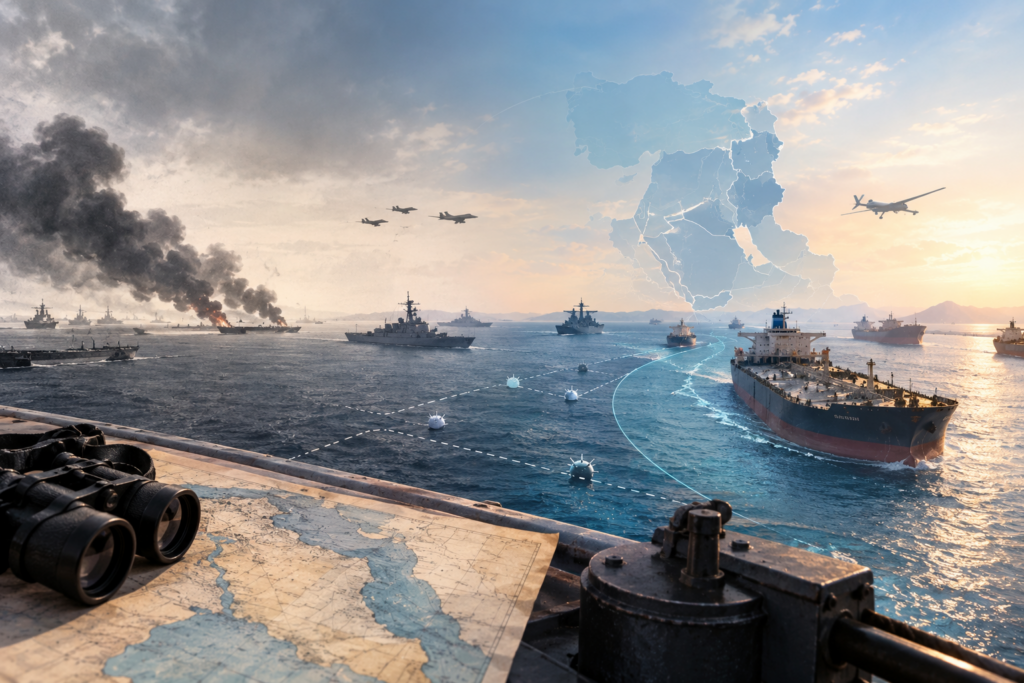
Wars are often difficult to end not because the parties cannot find an exit, but because they believe continued fighting will produce a better one. The current Gulf war raises this question precisely.
The current war that began with US and Israeli strikes on Iran calls to mind the first Gulf War, started by the Iraqi strikes on Iran in September 1980 and lasting for 8 years. It is not a replay of the Iran-Iraq War. The actors differ, the balance of power has shifted, military technology has changed, and international involvement is far greater. Yet the images are familiar: oil tankers, naval mines, Western fleets, threatened shipping lanes, Gulf states caught between geography and alliances, and the search for a political settlement each side can present as victory.
Iran’s use of naval mines is hardly new. During the ‘Tanker War’ of the 1980s, Tehran pushed part of the conflict into Gulf waters, targeting shipping linked to Gulf states supporting Baghdad, especially Kuwait and Saudi Arabia. Mines, speedboats and other forms of maritime pressure widened the costs of war beyond the battlefield.
In September 1987, US forces intercepted the Iranian vessel Iran Ajr laying mines near shipping routes. Seven months later, the frigate USS Samuel B. Roberts struck an Iranian mine, prompting a major American military response.
Tehran’s logic was simple: if other states were helping Baghdad sustain the war, why should its costs remain confined to Iran and Iraq?
The comparison becomes more revealing beyond the mines themselves.
During the Iran-Iraq War, Tehran struggled to match Baghdad across the full range of conventional power. It compensated partly through scale and attrition. At several stages, manpower itself became part of this equation, with large numbers of Revolutionary Guard and Basij forces committed to repeated offensives.
Today, the instruments are different, and the human cost to Tehran is far lower. One-way attack drones can serve some of the same attritional purposes: launched in numbers, they force an adversary to spend sophisticated and expensive interceptors against relatively cheap targets. If a drone is lost, the cost is material rather than human.
The two forms of warfare are not equivalent, militarily or humanly. But the logic is recognisable: if you cannot match superior power, make its use more expensive.
The battlefield is also wider.
In the 1980s, Iranian maritime pressure centred on the Gulf and the Strait of Hormuz. Today, Iran-aligned forces can extend the conflict into the Red Sea and Bab al-Mandeb, as the Houthis have repeatedly shown through attacks on shipping. Trade disruption is no longer tied to Hormuz alone.
Yet this wider reach carries a contradiction. The more successfully Iran and its allies turn Hormuz and the Red Sea into problems for the global economy, the harder it becomes to frame the conflict simply as one between Iran and its adversaries. Countries hit by higher transport costs, disrupted trade and energy insecurity may begin to view Iranian pressure itself as their problem.
That, in some ways, takes us back to the 1980s.
The United States did not enter the Iran-Iraq War as a direct belligerent. It was drawn more deeply into the Gulf as the Tanker War intensified. In 1987, Washington launched Operation Earnest Will, reflagging Kuwaiti tankers under the US flag and escorting them with the US Navy. A mission that began with convoy protection expanded into mine-clearing and eventually direct clashes with Iranian forces.
European governments also contributed to maritime security, although not under a single US-led command.
The important difference today is not that the West was more united then. It was not. The difference is that the mission was easier to define. A government could oppose both Baghdad and Tehran, remain outside the war and still regard keeping the Gulf open to international shipping as a separate strategic interest.
Today, that distinction is harder to sustain because the United States itself is a direct party to the conflict. ‘Protecting navigation’ therefore carries a larger political question: where does defending commercial shipping end, and participation in Washington’s war begin?
China is another major difference.
During the Iran-Iraq War, Beijing acted largely as a pragmatic arms supplier, selling to both sides. Today, it is by far the largest purchaser of Iranian oil, with US estimates indicating that it absorbs more than 90 per cent of Iran’s crude exports.
That does not make China a military ally of Iran, nor suggest that Beijing is prepared to bear the costs of war on Tehran’s behalf. Its economic interests with the wider Gulf are too substantial for its regional policy to be reduced to support for Iran.
But Tehran now has an economic outlet of a scale that did not exist in the 1980s. The assumption that military pressure will quickly translate into severe economic strangulation therefore requires caution.
The oil market has changed as well.
One paradox of the Tanker War was that the Gulf was in conflict while global oil markets, especially in the mid-1980s, suffered from oversupply. Prices fell sharply despite the war.
Today, the mere prospect of disruption in Hormuz can move crude prices, freight rates and insurance premiums before a single barrel is prevented from passing. Add pressure in the Red Sea, and the economic effects spread faster still.
This gives Iran greater capacity to globalise the economic costs of confrontation, even if it remains politically more difficult.
This brings us to the most revealing part of the current war: the Islamabad Memorandum.
Signed by the United States and Iran in June after months of fighting, it appeared to offer an exit both sides could plausibly live with. It was not a UN Security Council resolution and cannot be legally equated with Resolution 598, which later helped end the Iran-Iraq War. Its significance was political, not legal.
The memorandum gave both sides room to claim success.
Iran could argue that it had survived direct military pressure from the United States and Israel; that force had neither toppled the regime nor compelled surrender; and that its adversaries had ultimately returned to negotiations.
Washington could argue that military force had brought Iran back to the table and produced new arrangements concerning the war, maritime security and regional stability.
Neither narrative needed to be wholly true. That may not have mattered. Politics does not always require one side to acknowledge defeat before the other can claim victory.
Yet the agreement failed to hold, and the war resumed.
This is where 1987 becomes particularly relevant.
In July that year, the UN Security Council adopted Resolution 598, calling for a ceasefire and withdrawal to internationally recognised boundaries. Iraq accepted it. Iran did not, and the war continued for another year.
Tehran’s calculation was understandable: after seven years of war, why accept the available terms if further fighting might produce better ones?
The problem was that it did not.
Iraq recaptured the Faw Peninsula in April 1988. Further Iranian setbacks followed, while confrontation with the United States in the Gulf became more direct. By July, Tehran had accepted Resolution 598.
No dramatically better diplomatic offer had emerged. What changed was the cost of continuing.
When the ceasefire took effect in August 1988, neither side had secured territorial gains remotely proportionate to eight years of war and hundreds of thousands of deaths. Roughly two years later, border arrangements had returned close to where they had stood before the conflict.
But the region did not return to that state. Iran’s relationship with Iraq had changed, as had its relationship with the Gulf states. The US military presence in the Gulf became more deeply entrenched, and Gulf waters became part of a broader international security architecture. A war that ended geographically close to where it began left behind a different region.
Historical comparisons still require caution. The year 2026 is not 1988. Iran is not the Iran of the 1980s, the United States occupies a different position, and the regional order has changed.
History does not repeat itself mechanically. But strategic errors do.
In 1987, Iran had an available exit but did not believe it needed to take it. It kept fighting because it believed, or hoped, another year would improve the terms. A year later, it accepted an outcome close to the one previously available, after paying for another year of war.
The Islamabad Memorandum now raises the same question for all parties, not Iran alone.
If an agreement already existed that let each side walk away and tell its public it had prevailed, what additional gain now justifies continuing the war? And what will that gain cost?
One recurring mistake in thinking about war is assuming the hardest part is finding an exit. Sometimes the exit is already there, but the parties pass it by because they believe the next round will produce a better one. It may. Or they may return months or years later to almost the same door, with a far larger bill.
