

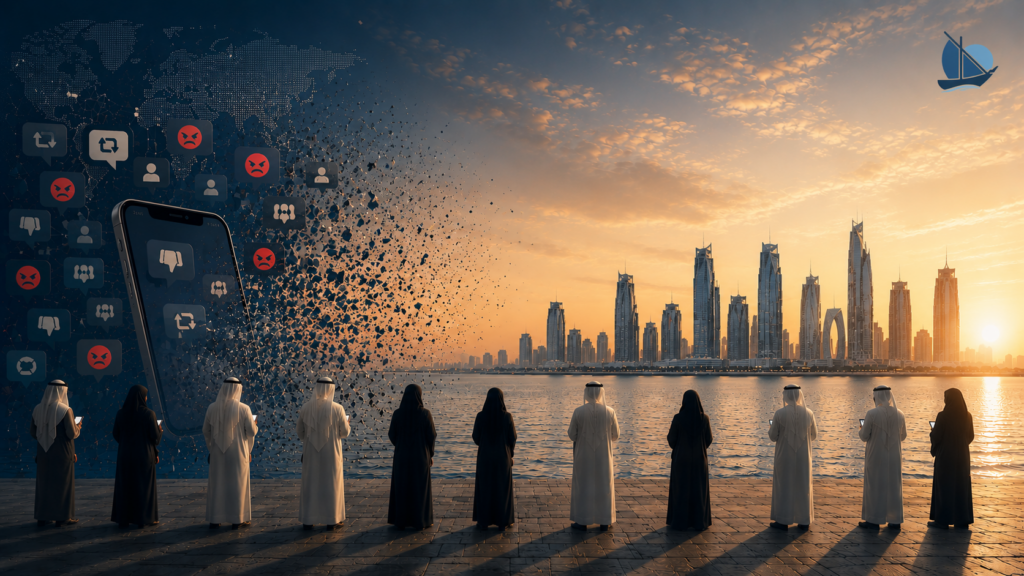
The recent conflict in the Gulf has generated repercussions extending beyond security and economic concerns to affect the social fabric of Gulf societies. Increasing signs of tension and polarization have emerged within the public sphere, particularly across social media platforms. As differences became more apparent in the positions adopted by some Gulf governments regarding the conflict and other regional issues, political disagreements increasingly spilled into public discourse and digital spaces. In some instances, these disagreements evolved into narratives of disloyalty, demonization, and incitement against particular states or populations based on their governments’ policies. At times, such rhetoric also targeted social groups and national communities within Gulf societies on the basis of sectarian, cultural, or tribal identities, despite their lack of direct involvement in the underlying political disputes.
This development can be understood within the broader context of how periods of acute crisis often expose latent social divisions and amplify existing political disagreements among states and governments. Under conditions of heightened polarization, disputes may no longer remain confined to official policies and political positions. Instead, they can extend to the populations and social groups associated with them, transforming political disagreements into identity-based tensions characterized by social exclusion and collective targeting.
The involvement of public figures, social media influencers, journalists, and commentators from across the Gulf and the wider Arab region has contributed to the wider dissemination of these negative narratives. The participation of individuals perceived to be closely connected to policymaking circles has further amplified their reach. In some cases, the absence of clear official positions condemning hate speech or calling for restraint has fostered varying perceptions regarding the degree of tolerance toward such discourse within certain states.
The nature of social media platforms has further intensified these dynamics and their negative consequences. Digital platform algorithms do not operate as neutral mechanisms for organizing content. Rather, they actively shape public debate through selective processes that prioritize certain forms of engagement. Content that generates controversy or provokes strong emotional reactions tends to attract higher levels of interaction and is therefore more likely to gain visibility and broader dissemination. During periods of crisis and political polarization, these dynamics can amplify the presence of exclusionary or extremist narratives beyond their actual prevalence within society. This creates the perception that such views are more widespread and influential than they truly are, expanding the scope of polarization and encouraging further engagement with confrontational forms of discourse. The cumulative effect is a deepening of their negative social impact.
The rise of this phenomenon also raises important questions concerning the balance between combating hate speech and safeguarding freedom of expression. Open debate on domestic and regional political issues constitutes a legitimate and essential component of public life. The challenge lies in limiting rhetoric that targets individuals, communities, or populations based on their identities, affiliations, or political opinions regarding contentious issues, while preserving space for legitimate criticism of public policies and governmental decisions.
Previous experiences in the Gulf suggest that the effects of divisive rhetoric frequently outlast the political crises that initially generated it. Although official relations between Gulf states have returned to normal following several past disputes, elements of social distrust and sensitivity persisted among segments of society. Negative perceptions also remained attached to some actors who played a prominent role in intensifying tensions during those periods. These experiences demonstrate the capacity of public discourse to produce long-term consequences that extend beyond the immediate political circumstances in which they emerge.
Against this backdrop, several Gulf states have introduced policies and legislative measures aimed at addressing hate speech and incitement. Saudi Arabia has issued official warnings emphasizing the legal accountability of individuals who promote such rhetoric, regardless of the groups targeted. More recently, Oman enacted legislation criminalizing acts and forms of expression deemed harmful to the Sultanate’s relations with friendly and neighboring states. It remains too early to assess the practical effectiveness of these measures in reducing hate speech or mitigating social polarization. Nevertheless, they reflect growing recognition of the risks associated with the escalation of such discourse. At the same time, ensuring that these measures do not evolve into restrictions on freedom of expression or objective criticism remains a critical challenge requiring careful attention.
These developments underscore the importance of addressing the social dimensions of regional crises alongside their political and security implications. Prolonged periods of polarization, accompanied by narratives of betrayal and hatred, can generate consequences that extend beyond the duration of the crises themselves. Such dynamics risk undermining relationships within national communities and among the peoples of the Gulf, even after the political tensions that initially fueled them have subsided.
In light of these challenges, there is a pressing need for balanced approaches that simultaneously protect freedom of expression and address hate speech and incitement. Such approaches should reinforce the distinction between legitimate criticism of policies and the targeting of human groups based on identity. Media institutions, educational systems, regulatory bodies, and influential actors on social media platforms all have important roles to play in limiting the spread of inflammatory content and promoting a culture of dialogue, pluralism, and mutual respect. The adoption of these measures could contribute to mitigating the social consequences of polarization and preserving the social cohesion that has historically connected Gulf societies during periods of crisis and beyond.
