

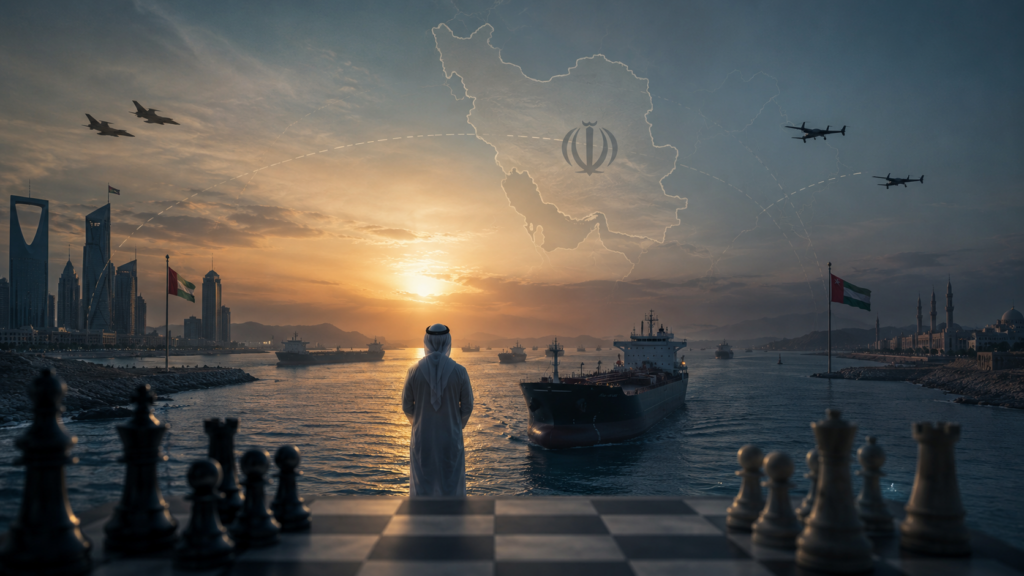
On 28 February 2026, the declared US-Israeli objectives of the war against Iran centred on destroying Iran’s nuclear programme, weakening its military capabilities and proxy networks, and ultimately pursuing a far more ambitious wager. Israel had persuaded its allies that the Iranian regime would fall.
Six months later, the conflict has undergone a dramatic transformation. Its centre of gravity has shifted into an entirely different arena, now focused overwhelmingly on navigation through the Strait of Hormuz, both its present reality and its future. This shift is highly significant because it means that, so far, the war has failed to reach the outcome envisaged when it began. What started as a war to reshape Iran has become a war over the conditions governing the economic and security orders in the Gulf.
What we have learned so far is that military victory does not necessarily translate into strategic victory. Iran has sustained devastating blows. Supreme Leader Ayatollah Ali Khamenei and senior military commanders were killed on the first day of the war. The country’s military infrastructure has been damaged, Iranian oil exports have fallen by around 85 per cent compared with pre-war levels, and the Iranian rial continues to haemorrhage value. Yet the regime remains cohesive. More importantly, Tehran retains the ability to impose significant regional costs through missiles and drones striking vessels passing through the Strait of Hormuz. The Venezuelan experience, where President Trump achieved extraordinary success, has not been replicated here. The world’s foremost military power and its most powerful regional ally, Israel, have undoubtedly succeeded in destroying a considerable portion of Iran’s capabilities. Yet they have failed to bring down the regime or even alter its political behaviour.
Despite President Trump’s repeated and extensive claims about the achievements of the war and the destruction of Iran’s nuclear programme and military capabilities, one of the most telling developments has been Washington’s effective shift towards more modest and immediate priorities. The central objective is now the restoration of oil and gas exports through Hormuz and the reduction of fuel prices. With the US congressional midterm elections approaching and public support among Americans for the war falling to around 31 per cent, the domestic cost of the war against Iran has become part of Washington’s calculations. This is also reflected in the new package of sanctions announced this week, which proved less severe than anticipated.
Iran does not want a return to full-scale war. It is undoubtedly exhausted and under considerable strain. Nevertheless, Tehran appears to believe that its internal cohesion and its capacity to inflict damage on the economic system surrounding it can enable it to emerge from the crisis in a position that allows it to rebuild and address at least some of its mounting domestic problems. Iran cannot defeat the United States and Israel. Yet its actions in the Strait of Hormuz and its attacks against Gulf states cannot be understood simply as a series of isolated acts of retaliation. Rather, they constitute a policy designed to spread the costs of the conflict across the region until conditions mature for the political settlement that Tehran is awaiting and seeking more urgently than any other party.
For decades, the Gulf states’ security doctrine rested on the assumption that US military bases would deter Iran and protect the members of the Gulf Cooperation Council. This war has exposed the other side of that equation: the presence of those bases makes the Gulf states, with the exception of Oman, part of the theatre of the US-Iranian war. Although Gulf states see no viable alternative to maintaining this alliance and continuing to rely on the United States, a contentious debate has emerged in Washington over whether some of the large US military installations and bases in the Gulf should be rebuilt. For Gulf capitals, this debate is unsettling. This is particularly true of US bases in Kuwait, Qatar and Bahrain, which Washington has discovered are highly exposed to Iranian missiles and drones. While Kuwait and Qatar may cover the costs of rebuilding these bases, Bahrain’s ability to do so remains uncertain.
The absence of a common Gulf position on the current crisis further complicates the situation and deepens the uncertainty. The United Arab Emirates has pursued an increasingly dual-track approach, oscillating between its position as a state bound by a serious and deep alliance with the United States and Israel against Iran and its role as a state seeking to capitalise on economic opportunities. Most recently, the UAE moved to suspend financial and economic dealings with Iran following the latest escalation. Before that, however, it was the UAE itself that restored flights between Dubai and Tehran. This suggests that Abu Dhabi has increasingly adopted a fluctuating posture, keeping its bets open across a range of possible scenarios. As a result, the Emiratis have lost a considerable degree of confidence in both Washington and Tel Aviv.
Saudi Arabia, which initially appeared more inclined towards deterring Tehran, quickly stepped back out of concern that it might slide into a direct war with Iran or its allies in Iraq and Yemen. Oman, meanwhile, finds itself caught between President Trump, who has twice repeated his threats against Muscat, and the Islamic Revolutionary Guard Corps, which refuses to accept Washington’s conditions. Qatar appears to be the most severely affected. Doha has recently cut the budgets of some government departments by around 30 per cent and foreign aid by approximately 85 per cent, while its liquefied natural gas has no alternative export route to the closed strait. Kuwait and Bahrain, for their part, remain largely confined to managing the crisis domestically rather than participating in shaping its day-to-day trajectory or determining its eventual outcome. Overall, the crisis has tested whether the Gulf states can rely on a unified Gulf security policy. The result of that test has been an unequivocal failure.
Israel entered the Gulf as a potentially valuable security partner for Gulf states confronting Iran. It has now become part of the Gulf’s security dilemma. Israel’s contribution to the war inflicted severe damage on Iran, but at the same time it offered Gulf states no significant advantage in defending their sovereignty and territory, apart from some air-defence systems supplied to the UAE. Israel can arguably be considered the biggest winner of the war. Tel Aviv succeeded in igniting a conflict that the United States went on to lead with its own armed forces, which are now facing ammunition shortages, while Gulf capitals have borne significant military and economic consequences. At a certain point, Tel Aviv quietly stepped back from the war, leaving the rest of its allies to continue the confrontation largely on their own.
Nevertheless, Gulf states now recognise the failure of the strategy of an “Israeli-Gulf camp”. One indication is Saudi Arabia’s decision to construct an unusual alliance and defence arrangement whose partners are Turkey and Pakistan, rather than Tel Aviv, as Washington had wanted. The Saudi manoeuvre does not represent an attempt to replace its alliance with the United States. Rather, it marks a measured shift from relying on a single ally towards building a network of allies.
Today, there is no prospect of returning the Strait of Hormuz to the conditions that prevailed before 28 February. The region’s strategic settings and geopolitical map have changed. What both Washington and Tehran now require is an end to this confrontation “without defeat”. The most likely scenario is therefore a period of fragile settlements punctuated by calibrated escalation. Any settlement of this complex situation must answer questions that can no longer be ignored: Who will guarantee freedom of navigation through the strait? What should be the limits of the US military presence in the region? What guarantees will Iran receive in return for refraining from disrupting energy flows? How will the sovereignty and territory of Gulf states be protected? And how can the United States and Iran extricate themselves from this war without either side being defeated?
This war has shattered the balance among states and the regional order that had prevailed in the Gulf. Iran can no longer be contained in the manner it once was. The United States is unwilling to provide year-round protection for the Gulf states and the Strait of Hormuz. Israel has lost some of its earlier momentum and confidence in its ability to reshape the region according to its own preferences. Finally, the Gulf states themselves are no longer aligned in their policies or in agreement over what they should do next.
Ultimately, the war did not change Iran in the way its adversaries intended. It has, however, changed the Gulf in ways that may now prove exceedingly difficult to reverse.
