

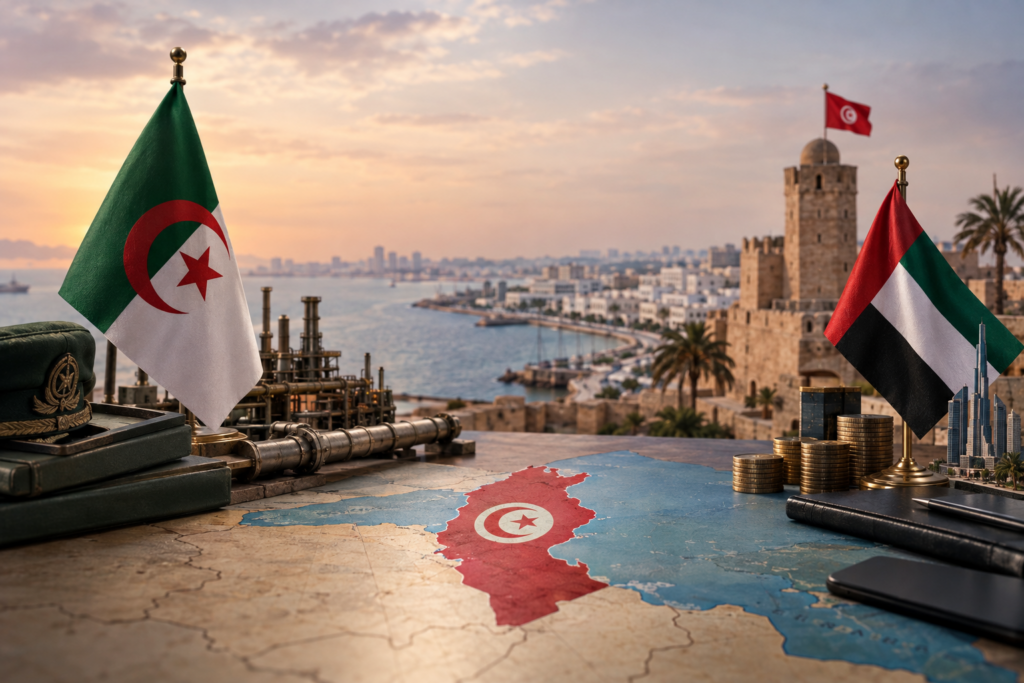
Six years of mounting tension and geopolitical rivalry between Algeria and the United Arab Emirates culminated on 10 September 2026, when Algeria announced the severance of diplomatic relations with Abu Dhabi. The Emirati ambassador was given 48 hours to leave the country, while Algerian airspace was closed to Emirati aircraft.
At first glance, the escalating confrontation appears to concern Algeria and the UAE alone. Tunisia, however, is far from insulated from its repercussions. Under President Kais Saied, Tunis has developed particularly close relations with the government of Algerian President Abdelmadjid Tebboune while maintaining substantial commercial, industrial and political ties with the UAE. This places Tunisia in an increasingly difficult geopolitical position. It must respond carefully to Algeria’s decisions in order to avoid alienating a powerful neighbour and strategic partner, while simultaneously preserving constructive relations with Abu Dhabi and safeguarding its own autonomy in foreign policy.
Background to the Crisis
Before Abdelmadjid Tebboune came to power in December 2019, Algerian-Emirati relations were generally strong across several areas. The relationship had also acquired a particular historical dimension because former Algerian president Abdelaziz Bouteflika served as an adviser to Sheikh Zayed bin Sultan Al Nahyan during the 1980s.
During Bouteflika’s presidency, Emirati companies secured significant economic privileges in Algeria. In 2009, DP World was awarded a concession to operate the Port of Algiers. Emirati capital also expanded into the tobacco and industrial sectors and benefited from investment opportunities that were exceptional by Algerian standards.
Relations nevertheless suffered a series of setbacks following the Arab uprisings. On 10 September 2026, Algeria’s Ministry of Foreign Affairs announced in a statement broadcast on state television that, “after exhausting all avenues capable of preserving bilateral relations, the Algerian government has decided today to sever diplomatic relations with the United Arab Emirates.” The statement also referred to what it described as an increase in “provocative or hostile actions” by the UAE.
Before the latest escalation and the withdrawal of Algeria’s ambassador from Abu Dhabi, many observers had identified Emirati normalisation with Israel as one of the principal sources of tension between the two capitals. Algeria’s concerns, however, predated the signing of the Abraham Accords in September 2020. Algiers had already accused the UAE of interfering in the affairs of Arab and African states.
These grievances centred primarily on Emirati support for Morocco over Western Sahara and Abu Dhabi’s ties with Libyan commander Field Marshal Khalifa Haftar. Algeria has also viewed Emirati involvement in Mali and Niger as having direct implications for its national security.
The roots of the dispute go further back. During Algeria’s 2019 Hirak protest movement against Abdelaziz Bouteflika’s rule, demonstrators raised slogans against both the UAE and Bouteflika amid allegations that Abu Dhabi sought to influence arrangements for Algeria’s post-Bouteflika political transition.
At the time, Emirati businessman Ahmed Hassan Al Shaibani had developed an extensive business presence in Algeria. His investments included the Algerian-Emirati Real Estate Development Company, the Algerian-Emirati STAEM tobacco company following the restructuring of Algeria’s national tobacco and matches company, SNTA, and a steel manufacturing company.
After the Abraham Accords were signed, Algerian concerns about Emirati-Israeli rapprochement intensified. Algiers feared that the expanding relationship could affect the security balance in the Maghreb. Those concerns were reinforced when the UAE became the first Arab state to open a consulate in Laayoune in Western Sahara in 2020. Tebboune’s government subsequently accused Abu Dhabi of financing large investment projects in Western Sahara and facilitating Israeli investment across African markets.
The question now is how the apparent breakdown in Algerian-Emirati relations will affect Tunisia and its already delicate strategic position.
Potential Pressures on Tunisia
President Tebboune has repeatedly stated that Algeria does not interfere in Tunisia’s internal affairs and respects Tunisian sovereignty. Yet Tunisia features prominently in his political and security discourse. Most recently, in July, he warned against any attempt to bring terrorism into Tunisia or isolate the country.
Tunisia is unlikely to remain unaffected by the rupture between Algeria and the UAE, even though its diplomacy under Kais Saied has increasingly been characterised by limited international engagement and relative isolation.
From September 2026 until March 2027, Tunisia holds the presidency of the Council of the League of Arab States. The position represents a significant test for Tunisian diplomacy ahead of the next Arab summit, particularly at a time when relations among several Arab states are marked by growing friction and, in some cases, outright diplomatic rupture.
In theory, Tunisia’s presidency of the Arab League could provide an opportunity for Tunis to act as an intermediary and seek to reduce tensions between Algeria and the UAE. Yet Tunisia’s relationship with Algeria has acquired particular weight under Kais Saied. Despite his broader international isolation, Saied has developed especially close relations with Abdelmadjid Tebboune and Egyptian President Abdel Fattah el-Sisi.
Algeria has provided significant political and financial support to Saied’s government. This has included financial deposits and guarantees intended to support the Tunisian economy during an acute fiscal crisis. Algeria is also Tunisia’s principal energy supplier. Tunisia purchases Algerian electricity and natural gas at preferential rates, while the pipeline carrying Algerian gas to Italy has crossed Tunisian territory for decades.
Military cooperation has also deepened. In October 2025, Algeria and Tunisia signed a joint defence agreement that was publicly celebrated in Algeria but initially treated with greater discretion in Tunisia. Tunisian authorities later described it as an update to a defence agreement dating back to 2001. The French newspaper Le Figaro, however, reported that it had obtained documents indicating that the agreement allows Algerian forces to operate up to 50 kilometres inside Tunisian territory for the purpose of combating terrorism and organised crime.
Diplomatically, Algeria has sought to promote a Maghreb framework that excludes Morocco while relying heavily on its growing coordination with Tunisia. It launched the “Periodic Tripartite Meeting” bringing together Algeria, Tunisia and Libya, an initiative some observers interpret as an attempt to politically marginalise Morocco.
There are also indications of less explicit pressure on Tunisia to align with Algerian diplomatic positions. This has contributed to an erosion of Tunisia’s traditional neutrality, particularly over Western Sahara. Tunisia has increasingly moved closer to Algeria’s position at Morocco’s expense. The clearest example came in August 2022, when Kais Saied personally received Polisario Front leader Brahim Ghali in Tunis. Morocco responded by recalling its ambassador.
Although Algeria continues to reject accusations that it interferes in Tunisia’s domestic affairs, the evolution of bilateral relations suggests the existence of a form of soft pressure exercised under the language of “converging views.” Tunisia’s departure from its previous neutrality over Western Sahara is one indication of this trend.
The Algerian-Emirati crisis therefore raises the possibility that Algiers could exert further pressure on Tunisia in the name of strategic partnership and bilateral cooperation. This possibility is particularly significant given the scale of existing military and security agreements between the two countries.
Tebboune has repeatedly invoked the principle that “Tunisia’s security is part of Algeria’s security” when discussing security cooperation and Algeria’s readiness to protect Tunisia against terrorism. Such language can be interpreted as extending Algeria’s security perimeter into Tunisia and as signalling a potential willingness to intervene on Tunisia’s behalf.
This dynamic may also constrain Tunisia’s ability to develop broader security or military partnerships with Western powers such as the United States or NATO if Algeria considers such partnerships a threat to its strategic depth. Tunisia’s room for independent manoeuvre toward the UAE may consequently be narrower than its bilateral interests with Abu Dhabi would otherwise suggest.
The central question is therefore whether Tunisia can withstand potential Algerian pressure while preserving its relationship with the UAE.
Ideally, the next Arab summit would be preceded by Tunisian diplomatic efforts to narrow the gap between Abu Dhabi and Algiers. So far, however, there are no clear signs of such an initiative or of discreet Tunisian mediation. Given the depth of the dispute, it may nevertheless be premature to judge the prospects of mediation before any serious effort has begun.
Tunisia has substantial interests in maintaining its relationship with the UAE. Bilateral ties have historically included financial assistance, liquidity support, infrastructure investment, tourism and real estate projects, as well as loans and deposits intended to support Tunisia’s strained public finances.
The UAE is also an important labour market for Tunisian workers and professionals. The two countries have entered advanced formal negotiations over a Comprehensive Economic Partnership Agreement aimed at removing tariff barriers and increasing trade flows. Forty-two Emirati companies currently operate in Tunisia, generating employment in sectors including telecommunications and renewable energy. Emirati investment also includes the Tunis Sports City project being developed by the Bukhatir Group.
Conclusion
Geographically and strategically, Tunisia cannot afford to abandon close security and energy coordination with Algeria. For Algiers, Tunisia’s security forms part of its own national security environment.
The UAE, by contrast, possesses significant financial and investment leverage. Its geographic distance means that Emirati influence is more likely to remain primarily economic, political and diplomatic. Abu Dhabi’s objective would be to discourage Tunisia from becoming fully integrated into an Algerian-led regional axis without creating an unnecessary confrontation with Tunis.
The UAE has so far maintained a measured tone despite the sharp language used by the Algerian Foreign Ministry and has continued to signal an interest in restoring stability to bilateral relations.
Abu Dhabi also has a direct interest in maintaining constructive ties with Tunisia because of Tunisia’s importance to the stability of Libya. Yet intensifying Algerian-Emirati competition in Libya and the Sahel continues to complicate Tunisia’s strategic position. As the rivalry deepens, security coordination along Tunisia’s eastern and southern borders is likely to become increasingly difficult, narrowing Tunis’s room for manoeuvre between two partners whose regional priorities are steadily diverging.
