

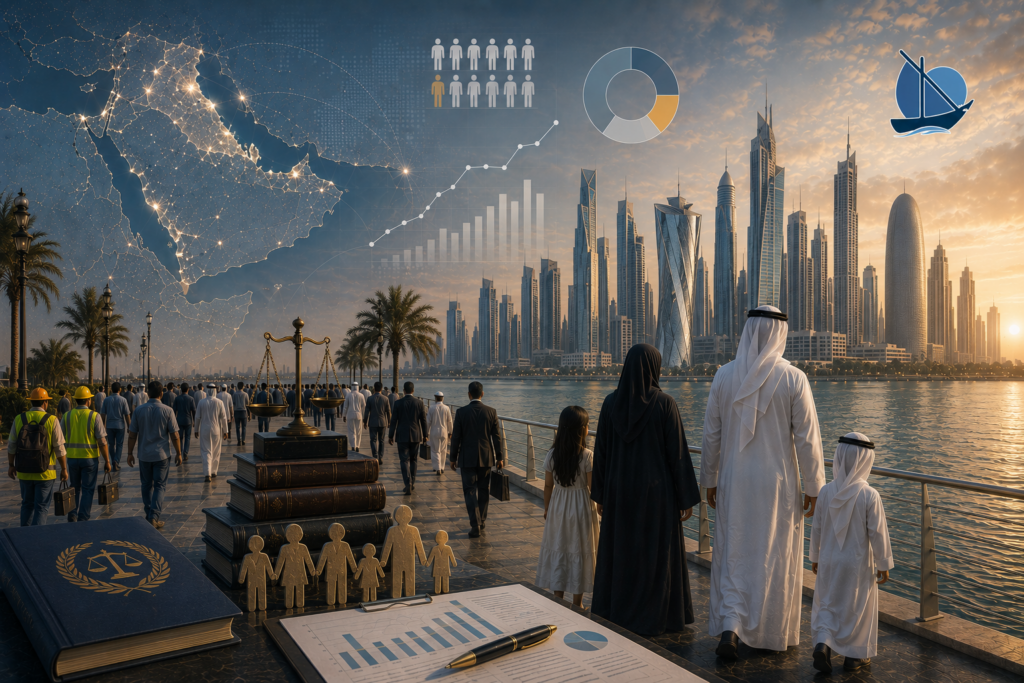
Over the course of just half a century, the Gulf states have transformed from relatively small and socially homogeneous societies into some of the most migration-dependent countries in the world. In several Gulf states, citizens now constitute a numerical minority within their own countries. At the same time, governments across the region have embraced more open economic and social policies aimed at attracting foreign investment, global talent, and long-term expatriate residents.
This new reality has placed the Gulf before a complex equation. Gulf economies continue to rely heavily on foreign labor and international expertise to sustain large-scale development projects and achieve post-oil diversification goals. Yet concerns over national identity, social cohesion, and long-term stability are becoming increasingly difficult to ignore.
Major Demographic Transformations
The oil boom that began in the 1970s enabled Gulf governments to launch massive development projects that required millions of foreign workers and professionals. Over time, expatriate labor evolved from a supplementary economic component into a structural pillar of Gulf economies, spanning construction, services, healthcare, technology, and aviation.
Recent estimates indicate that the population of the Gulf Cooperation Council (GCC) states has risen from roughly 10 million people in the mid-1970s to nearly 60 million today, with expatriates accounting for more than half of the total population. Countries such as the United Arab Emirates and Qatar have become among the most foreigner-dependent societies in the world, with non-citizens representing nearly 90 percent of the population. Expatriates account for around 70 percent of the population in Kuwait and more than half in Bahrain, while the proportion remains comparatively lower in Saudi Arabia and Oman.
This rapid demographic transformation has fundamentally reshaped Gulf societies and urban life. Gulf cities have become multilingual and multicultural spaces. Significant demographic imbalances have also emerged, particularly the large disparity between men and women due to the concentration of male labor migrants in construction and service sectors.
These changes have produced social patterns that were previously unfamiliar in Gulf societies, including large bachelor-worker districts and a growing dependence on services designed primarily for expatriate communities. Some researchers now describe the Gulf experience as a profound demographic transformation that extends far beyond temporary economic necessity.
Economic Openness and Changing Migration Policies
For decades, Gulf states treated expatriates primarily as temporary workers operating under restrictive sponsorship systems that kept them outside the social and political sphere of local society. In recent years, however, Gulf governments have gradually begun to rethink this model by adopting more open and stable residency policies for selected categories of foreigners.
The UAE introduced the “Golden Visa” system, granting investors and skilled professionals renewable long-term residency permits. The country also amended its nationality laws to allow citizenship for limited categories of investors and highly skilled individuals. Saudi Arabia adopted a similar approach through its “Premium Residency” program, designed to attract investors and professionals as part of a broader strategy to position the kingdom as a global economic hub.
These policies reflect a growing Gulf recognition that global economic competition increasingly depends on attracting talent, expertise, and human capital. Mega-projects launched across the region, from Saudi Arabia’s NEOM to the financial and business hubs of the UAE and Qatar, require a scale of human resources and specialized expertise that local populations alone cannot provide.
Yet this openness remains highly selective. The main beneficiaries are investors and highly skilled professionals, while the vast majority of foreign workers continue to operate under temporary residency arrangements and unstable legal conditions. This dynamic has created a dual structure within Gulf societies: a relatively stable expatriate elite alongside a much larger population of temporary low-income workers with limited protections and rights.
Different Gulf Approaches to Demographic Management
Although Gulf countries face broadly similar demographic pressures, their responses differ significantly.
The UAE represents the region’s most open model. It has embraced a discourse centered on economic openness, multiculturalism, and global competitiveness, positioning itself as an international hub for business and residency. Qatar has also relied extensively on foreign labor, particularly in infrastructure projects associated with hosting the 2022 FIFA World Cup.
Kuwait, by contrast, has adopted a more cautious approach. Political debate in recent years has increasingly focused on restoring demographic balance and reducing dependence on expatriates, particularly after the COVID-19 pandemic revived concerns about the structural vulnerabilities created by excessive reliance on foreign labor. Oman has pursued “Omanization” policies aimed at replacing expatriate workers with citizens in selected sectors and reducing foreign labor dependency where possible.
Saudi Arabia occupies a middle position between these two models. The kingdom continues to pursue labor nationalization policies designed to reduce unemployment among Saudi citizens, while simultaneously depending on millions of expatriates to execute large-scale economic projects linked to Vision 2030. Crown Prince Mohammed bin Salman has openly stated that Saudi Arabia aims to increase its population to between 50 and 60 million by 2030, implying continued large-scale reliance on foreign residents in the coming years.
Social Stability and Identity Concerns
These demographic transformations generate challenges that extend beyond economics into the social, cultural, and security spheres.
At the social level, concerns over national identity, language, and cultural continuity are becoming more pronounced, especially in countries where citizens are now numerical minorities. The temporary nature of expatriate life also limits deeper integration into local society, contributing to the emergence of parallel communities that remain culturally and linguistically separate from citizens.
This challenge is becoming increasingly visible through the expanding use of foreign languages across commercial spaces, workplaces, and urban life, particularly in cities such as Dubai and Manama. Some Gulf intellectuals and policymakers now warn that local culture risks gradually losing ground in everyday public life.
Economically, expatriate labor remains indispensable to growth and development. Yet heavy dependence on low-cost labor raises serious questions about the long-term sustainability of the Gulf economic model. Large sectors of Gulf economies continue to rely on inexpensive manpower instead of investing more aggressively in productivity, technology, and workforce development for citizens. Expatriate remittances also result in billions of dollars leaving Gulf economies each year.
Security concerns are also becoming more sensitive as expatriate communities grow in size and diversity. Large populations that remain only partially integrated into society could create future pressures related to social cohesion and crisis management during periods of economic or political instability.
The Gulf Toward 2050
Most demographic projections suggest that Gulf populations will continue to grow over the coming decades, driven by sustained demand for foreign labor and international expertise. Economic diversification plans and mega-projects will likely make it difficult for Gulf states to substantially reduce their reliance on expatriates.
The central challenge, however, is no longer simply the size of the population. It is the future shape of Gulf society itself. Gulf states increasingly face the task of balancing economic openness with social stability, while maintaining national identity in an era of accelerating globalization.
Some Gulf governments have already begun to recognize that the traditional model based on temporary low-cost labor is no longer sustainable over the long term. As a result, newer policies increasingly favor attracting skilled professionals and expatriate families rather than relying exclusively on transient labor forces. These policies are being implemented alongside workforce nationalization and citizen training programs.
Ultimately, the future of social stability in the Gulf will depend on how successfully these states manage their demographic transformations. Economic openness has brought the region unprecedented growth and modernization, but it has also produced deep challenges related to identity, social cohesion, and the relationship between citizens and residents.
The Gulf succeeded over previous decades in building an exceptional economic model. It now faces a more difficult test: how to build stable and balanced societies amid demographic transformations that may reshape the region in unprecedented ways.
