

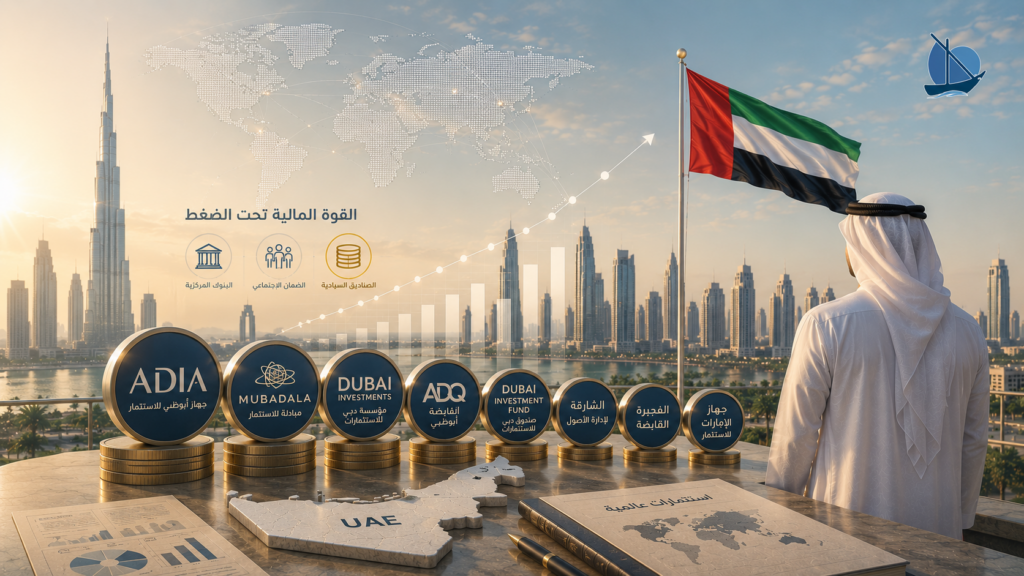
The sovereign wealth funds of the United Arab Emirates rank first in the Arab world, with assets equivalent to nearly four times the country’s gross domestic product. They play a central role in the Emirati economy. The Iran war demonstrated the importance of these funds at both the financial and investment levels. Yet this influence remains heavily concentrated in Abu Dhabi and Dubai, while some funds have also recorded weak financial performance and negative accounting outcomes.
A sovereign wealth fund is a public investment institution that allocates capital domestically and internationally in pursuit of profit. Public investment, however, is not limited to sovereign funds alone. Globally, public investment institutions generally fall into three categories: central banks, social security institutions, and sovereign wealth funds.
In May 2026, the total assets of these institutions worldwide reached approximately $60.7 trillion. Of this amount, $17.3 trillion belonged to central banks, $27.6 trillion to social security institutions, and $15.8 trillion to sovereign wealth funds, according to estimates by Global SWF. The United States and China together account for roughly one-third of global public investment assets. Most American public investment is concentrated in social security institutions, while China places greater emphasis on sovereign wealth funds.
In the UAE, total public investment assets reached approximately $3.083 trillion, placing the country first in the Arab world and fourth globally after the United States, China, and Japan.
Across the Gulf, sovereign wealth funds account for the largest share of public investments. In the UAE, sovereign wealth fund assets total around $2.695 trillion, equivalent to approximately 87 percent of the country’s total public investments. Comparable figures stand at 84 percent in Qatar, 83 percent in Kuwait, 58 percent in Saudi Arabia, 53 percent in Oman, and 52 percent in Bahrain.
The UAE central bank’s official reserves rank second, totaling approximately $274 billion, or around 9 percent of total public investments. These reserves include foreign stocks and bonds, deposits in overseas banks, IMF reserve assets, and monetary gold holdings.
The country’s social security funds hold approximately $113 billion, equivalent to around 4 percent of public investments. Their resources derive from investment returns, government contributions, and payments by employees, workers, and employers.
The UAE has nine sovereign wealth funds. Abu Dhabi controls four, Dubai two, while Sharjah and Fujairah each possess one. There is also one federal sovereign fund. The remaining emirates do not operate sovereign wealth funds.
The Abu Dhabi Investment Authority, established in 1976, is the oldest sovereign fund in the UAE and the largest in the Gulf. Its assets total approximately $1.128 trillion, according to the Sovereign Wealth Fund Institute, ranking fourth globally after the Norwegian and Chinese funds.
Lumaad is the newest Abu Dhabi sovereign investment company. It was established under Law No. 6 of 2025 and quickly acquired a stake in Modon Holding after its creation.
Mubadala Investment Company was established in 2002 and is owned by Abu Dhabi. Its assets total approximately $384.9 billion, placing it 14th globally.
ADQ, the Abu Dhabi Developmental Holding Company, was created in 2018 with estimated assets of approximately $263.3 billion, ranking 16th worldwide. It oversees 25 companies operating across 130 countries. In January 2026, Abu Dhabi’s Supreme Council for Financial and Economic Affairs decided to merge ADQ with Lumaad.
Dubai Holding Investments was established in 2006 and holds approximately $429 billion in assets, ranking 13th globally. It controls more than 1,300 companies operating in 65 countries.
Dubai Investment Fund was established in 2021 with assets totaling approximately $80 billion, ranking 26th worldwide.
Sharjah Asset Management was founded in 2008 with assets valued at approximately $10 billion, ranking 60th globally.
Fujairah Holding controls assets estimated at around $500 million.
The Emirates Investment Authority, established in 2008, is the UAE’s only federal sovereign wealth fund. Its assets total approximately $102 billion, placing it 22nd globally.
Legal Structure
Sovereign wealth funds are legally separate entities from government institutions and are governed by their own laws. In principle, governments are not legally responsible for the obligations of sovereign funds, and third parties cannot pursue claims against the state related to fund activities.
In practice, however, this independence is limited. Senior positions within Emirati sovereign funds, including board chairs and sometimes chief executives, are frequently occupied by individuals closely connected to ruling families and holding senior government or private sector positions.
Annual fund budgets prepared by fund boards also require approval from emirate governments. Boards are obligated to submit annual reports addressing fund performance and profitability.
From a legal perspective, sovereign funds globally fall into two categories: funds dedicated to future generations and funds without a fixed generational allocation. Most Gulf sovereign funds, including all Emirati funds, belong to the latter category. Article Five of the law regulating the Dubai Investment Fund, for example, states that the fund serves both present and future generations.
The legal relationship between sovereign funds and public budgets carries major economic implications. UAE laws do not establish detailed rules governing withdrawals from or financing of sovereign funds. This grants emirate governments broad discretion. By contrast, Kuwaiti law restricts withdrawals from the assets of the Kuwait Investment Authority and imposes clear financing standards. Bahrain’s Future Generations Reserve Fund allocates revenue based on oil prices and prohibits withdrawals except through legislation.
This legal relationship between sovereign wealth funds and governments gained greater importance following the US-Israeli war against Iran.
UAE laws define the purpose of sovereign wealth funds as investing across multiple sectors to generate “rewarding profits.” One of the primary uses of these profits is financing emirate budgets. The success of a sovereign fund therefore depends largely on the rate of return generated relative to the size of its assets.
Investment Activities
Emirati sovereign wealth funds invest across a wide range of domestic and international sectors.
Mubadala maintains major investments in oil and petrochemicals, which account for roughly one-third of its portfolio. It owns a controlling stake in the Spanish energy company Cepsa, one of Europe’s largest oil firms. Mubadala also fully owns the Canadian company Nova Chemicals.
The fund maintains major investments in technology and industry. It owns 82 percent of the multinational semiconductor manufacturer GlobalFoundries. Mubadala is also heavily invested in aviation and telecommunications. It fully owns Strata Manufacturing, which specializes in aircraft structures and reportedly produced more than 60,000 components over the past decade. Mubadala also fully owns Yahsat, a satellite communications company operating across the Middle East and Africa with five satellites.
ADQ acquired a major stake in Turkey’s Odeabank in 2024. It also purchased 49 percent of the Australian infrastructure company Plenary Group. One of its largest projects is a $35 billion investment in Egypt’s Ras El Hekma development on the Mediterranean coast. The project involves extensive real estate and infrastructure development and is expected to cost approximately $150 billion overall.
In 2025, ADQ launched several additional investments, including a joint venture with Orion Resource Partners in mining sectors such as iron and copper. ADQ also partnered with Energy Capital Partners, with both sides committing $25 billion equally to develop energy projects in the United States.
Economic Importance
The assets of Emirati sovereign wealth funds have grown rapidly in recent years. The Abu Dhabi Investment Authority increased its assets from approximately $790 billion in 2022 to more than $1.128 trillion in 2026. Dubai Holding Investments increased from approximately $309 billion to $429 billion over the same period.
As a result, the global influence and economic importance of Emirati sovereign wealth funds expanded significantly.
In both 2024 and 2025, Emirati funds ranked among the world’s leading sovereign investors. Combined sovereign wealth fund assets amount to approximately 489 percent of the UAE’s GDP, compared to around 73 percent in Saudi Arabia.
The UAE’s federal structure also matters. Sovereign wealth funds, like natural resources, belong primarily to the emirates that established them. Abu Dhabi alone controls sovereign assets totaling approximately $1.877 trillion, equivalent to around 609 percent of the emirate’s GDP.
Abu Dhabi by itself controls sovereign wealth exceeding the combined sovereign wealth funds of Saudi Arabia, Qatar, Bahrain, and Oman.
Dubai’s two sovereign funds together control approximately $509 billion, equivalent to around 346 percent of the emirate’s GDP. Sharjah’s and Fujairah’s sovereign assets correspond to approximately 24 percent and 6 percent of their respective GDPs.
These figures illustrate that the UAE occupies a leading global position in sovereign wealth. Yet this financial power remains concentrated overwhelmingly in Abu Dhabi and Dubai.
In recent years, Emirati sovereign funds have expanded beyond traditional sectors such as real estate and finance into artificial intelligence and advanced technologies. One prominent example is the Stargate project.
Large-scale industrial investments are also expected to generate technological expertise in both civilian and military sectors. Expanding investments have also increased employment capacity. ADQ employs approximately 86,000 workers, while Dubai Holding Investments employs around 252,000 people.
International investments by Emirati sovereign funds also reinforce the UAE’s geopolitical influence and broader role in international relations.
Weak Profitability
Emirati sovereign wealth funds officially aim to generate strong financial returns. This objective appears repeatedly in their governing laws. Yet evaluating their actual financial performance remains difficult because most funds do not publish detailed annual reports.
Official platforms often provide highly general and promotional information rather than transparent accounting data.
A comparison between Norway’s sovereign wealth fund and Dubai Holding Investments illustrates the gap in performance.
During the first half of 2025, Norway’s sovereign wealth fund achieved a net profit of €58.7 billion, equivalent to an annual return of approximately 7.1 percent of assets. By the third quarter of 2025, profits reached €88 billion, equivalent to around 6.7 percent of assets.
Dubai Holding Investments reported profits of AED 67.5 billion in 2024, equivalent to approximately 4.6 percent of assets. Its profitability therefore remained significantly below that of the Norwegian fund.
Although Dubai Holding’s profits improved compared to AED 36.1 billion in 2022, equivalent to only 3 percent of assets, the institution still suffered a major loss of AED 15.5 billion in 2020.
Some observers attributed these losses to the economic effects of the COVID-19 pandemic. Yet not all sovereign funds experienced similar outcomes. Norway’s sovereign wealth fund used the collapse in global stock prices during the pandemic to expand investments and generated approximately €100 billion in profits during 2020, equivalent to 10.9 percent of assets.
Dubai Holding Investments failed to capitalize on that opportunity and instead recorded major losses.
Mubadala also experienced a notable investment failure involving New York’s Chrysler Building. In 2008, Mubadala purchased a 90 percent stake in the tower for $800 million, excluding the land value. Shortly afterward, land lease costs increased sharply alongside other expenses. In 2009, Mubadala sold the building for only $151 million, incurring heavy losses.
The Impact of the Iran War
The US-Israeli war against Iran had a profound impact on the UAE economy and its sovereign wealth funds. Iran launched extensive attacks against Emirati civilian and military facilities, including 521 ballistic missiles and 2,141 drones. The scale of these attacks was roughly equivalent to the total attacks directed against all other Gulf Cooperation Council states combined.
The war sharply increased military expenditures and infrastructure repair costs.
Before the conflict, the UAE exported approximately 3.5 million barrels of oil per day through the Strait of Hormuz. Following the closure of the Strait, exports shifted toward the alternative pipeline connecting Habshan in Abu Dhabi to the port of Fujairah on the Gulf of Oman. Yet the pipeline’s maximum capacity does not exceed 1.8 million barrels per day.
To strengthen public finances, the UAE decided to increase future oil exports to five million barrels per day. To achieve this goal, the country withdrew from OPEC and OPEC+ beginning in May 2026.
Higher exports are expected to increase state revenues and support the UAE’s pledge to invest $1.4 trillion in the United States over ten years. These investments will largely be financed through sovereign wealth funds.
At the same time, sovereign funds are expected to finance the expansion of the Fujairah pipeline.
The Iran war affected Emirati sovereign funds in two principal ways. First, declining oil and tourism revenues have made it more difficult to expand fund assets, limiting future investment capacity. Second, sovereign funds are reassessing their investment priorities in response to the conflict.
Funds must now balance two competing obligations: fulfilling long-term investment commitments to the United States while prioritizing domestic investment in defense, energy, food security, and infrastructure.
The conflict also reduced the UAE’s broader financial flexibility because of falling oil revenues, declining tourism income, rising military expenditures, and slower economic growth.
Despite these pressures, international credit rating agencies maintained the UAE’s high sovereign rating because of the enormous scale of its sovereign wealth assets.
Although some Emirati sovereign funds have recorded weak financial results, these institutions have nevertheless succeeded in diversifying state revenues and strengthening the UAE’s economic position. Despite the severe economic consequences of the Iran war, sovereign wealth funds continue to play a critical role in supporting the country’s domestic and international financial stability.
