

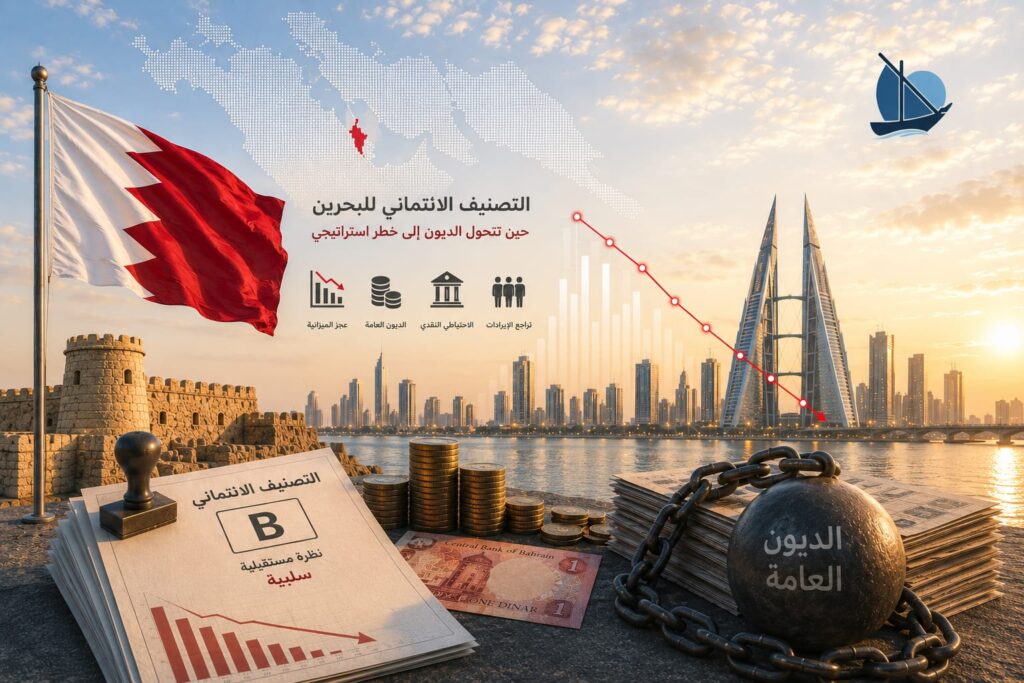
For several years, Bahrain’s credit rating has been on a continuous downward trajectory. Most recently, the country was downgraded to a “B” rating with a stable outlook, the weakest rating among Gulf Cooperation Council states. Following the war against Iran, the outlook shifted from stable to negative. This deterioration resulted from several interconnected factors, most notably rising fiscal deficits, escalating public debt, and declining foreign currency reserves.
A sovereign credit rating measures a state’s ability to meet its financial obligations, particularly debt servicing, while also reflecting the level of investment risk associated with the country. Credit ratings influence both lenders and borrowers because they directly affect borrowing costs. The lower the rating, the higher the interest rates on loans. Ratings also shape investment decisions. Gulf states therefore pay close attention to maintaining and improving their sovereign ratings.
Credit assessments are conducted by specialized agencies. The most influential are S&P Global, Moody’s, and Fitch Ratings. These are private American firms that dominate the global ratings industry. Other agencies exist, including China’s Dagong, Europe’s Scope Ratings, and Japan’s JCR, but the three American agencies continue to exercise near-total control over global sovereign ratings.
Rating agencies function as research institutions. They evaluate broad economic indicators and often hold meetings with representatives of the state under review.
Credit ratings are organized on a scale. At the top stands the “AAA” category, which indicates an extremely strong ability to repay debt and minimal investment risk. At the bottom stands the “D” category, which signals default and maximum risk. The S&P scale contains 23 ratings, with minor differences in terminology and structure across agencies.
Each rating is accompanied by an outlook that can be stable, positive, or negative. A stable outlook suggests limited likelihood of change. A positive outlook signals the possibility of an upgrade, while a negative outlook points toward potential downgrades.
A Continuous Decline
Bahrain’s sovereign rating has steadily deteriorated over the past decade and a half. In 2011, the country held a BBB rating, the ninth level on S&P’s scale. In 2021, it declined to BB, the twelfth level. In 2023, it fell again to B+, the fourteenth level. By November 2025, Bahrain reached a plain “B” rating, the fifteenth level on the scale. In just fourteen years, the country lost six rating levels. Another downgrade followed in April 2026 because of the economic consequences of the Iran war.
Bahrain now ranks last among GCC states in sovereign credit quality. The UAE and Qatar both hold AA ratings, the highest in the Arab world. Kuwait follows with AA-, Saudi Arabia with A, and Oman with BBB-.
The ratings assigned to Qatar and the UAE are equivalent to those held by countries such as the United Kingdom and Belgium. Bahrain, meanwhile, shares the same rating category as Egypt and Kenya.
S&P’s downgrade of Bahrain generated criticism from some observers who argued that other agencies had not followed the same path. Moody’s, for example, maintained Bahrain’s B2 rating from 2022 through 2025.
In practice, however, the criticism is misleading. Moody’s B2 rating corresponds directly to S&P’s B rating. Both agencies therefore place Bahrain at the same level of credit risk with a stable outlook during the same period. The difference lay mainly in timing. Until late 2025, S&P had been slower than Moody’s in reflecting Bahrain’s deterioration. Fitch also assigned Bahrain a B rating, aligning with both agencies.
These agencies rely on a combination of positive and negative indicators when evaluating Bahrain.
Positive indicators include the growing importance of non-oil revenues in the state budget, with oil revenues now accounting for roughly half of total public income. Tax revenues constitute the largest non-oil source. Non-oil exports, particularly aluminum exports, also play a major role in Bahrain’s trade balance.
Bahrain’s services account historically recorded surpluses because of strong tourism revenues before the Iran war. This distinguishes Bahrain from most other GCC economies, which often run deficits in services trade. The banking sector also maintains significant economic importance and contributes heavily to GDP.
The negative indicators are more severe. They include persistent fiscal deficits, rising public debt, growing debt servicing costs, and weak foreign reserves. The government also faces structural obstacles in reforming public finances, including political constraints.
Bahrain’s current rating reflects the interaction between these positive and negative factors. Yet the most important driver behind the decline remains the sustained rise in public debt.
Excessive Public Debt
Bahrain suffers from a chronic and significant fiscal deficit that continues to weigh heavily on its sovereign rating. In the 2026 state budget, the deficit reached approximately BHD 1.078 billion, equivalent to 5.6 percent of GDP. By international standards, this represents a high deficit ratio.
Non-productive sectors play a major role in worsening the fiscal crisis, particularly military spending. Bahrain allocates a substantial share of public expenditures and imports to defense procurement. Relative to the size of its economy, the country ranks among the world’s largest arms importers.
Persistent fiscal deficits weaken foreign currency reserves, a key factor in sovereign downgrades because it reduces the state’s ability to meet financial obligations. Bahrain’s reserves declined from BHD 1.773 billion in 2011 to BHD 1.364 billion in 2025. S&P does not expect meaningful reserve growth over the coming three years.
Fiscal deficits and public debt are deeply interconnected. Rising interest payments have contributed to expanding public expenditures, which in turn widened fiscal deficits. Repeated deficits forced the government to rely increasingly on borrowing, accelerating debt accumulation.
Under GCC fiscal standards modeled directly on the European Maastricht criteria, public debt should not exceed 60 percent of GDP. Beyond that threshold, debt is considered excessive and harmful to credit quality.
In 2011, Bahrain’s public debt stood at BHD 3.548 billion, equivalent to 32 percent of GDP. By 2025, it had surged to BHD 18.5 billion, or approximately 133 percent of GDP, more than double the accepted threshold. S&P projects that the ratio could reach 139 percent by 2028.
Debt servicing costs rose sharply alongside the increase in debt. Interest payments climbed from BHD 115 million in 2011 to BHD 1.031 billion in 2025.
At the beginning of this period, debt interest represented only 6.4 percent of Bahrain’s reserves. By 2025, the ratio reached 75.6 percent. Interest payments once equaled roughly half the Education Ministry’s budget allocation. They now exceed it by more than three times.
Debt servicing has become so burdensome that roughly two-thirds of Bahrain’s oil revenues are now required simply to cover interest obligations.
The relationship between debt levels and interest costs also reflects rising borrowing risk. In 2011, interest payments represented 3.2 percent of total public debt. By 2025, the ratio rose to 5.6 percent. This indicates that Bahrain is paying increasingly high interest rates, especially on external borrowing, which constitutes around 60 percent of total debt.
This trend is particularly troubling because global interest rates have generally been moving downward during the same period.
Interest costs have also risen dramatically relative to government revenues. In 2011, interest payments accounted for 6.9 percent of public revenues. By 2026, the figure reached 30.5 percent. Fitch noted in its latest Bahrain report that this ratio is roughly double the average among countries holding a B rating, implicitly signaling the possibility of further downgrades.
The 2026 budget projects debt interest payments to rise again to BHD 1.155 billion. This provides little incentive for rating agencies to improve Bahrain’s rating outlook in the short term.
Why Did the Debt Ceiling Increase?
In 2023, Bahrain issued Decree No. 13 authorizing the Ministry of Finance to secure loans totaling BHD 16 billion. In 2024, Decree No. 10 amended the framework and raised the debt ceiling to BHD 18 billion.
According to the Ministry of Finance, the increase resulted from three main factors.
The first involved the Electricity and Water Authority, which failed to pay its gas bills because revenues collected from consumers did not cover costs. The government therefore intervened to cover the payments.
Under Bahrain’s Fiscal Balance Program, the authority’s accounts were supposed to reach balance by 2021. Its inability to meet obligations suggests that the reform program failed in this area.
The second justification involved rising debt servicing costs. The Ministry argued that interest payments initially projected at BHD 835 million in the 2024 budget ultimately rose to BHD 945 million in the final accounts.
This explanation, however, is difficult to sustain. Decree No. 10 raising the debt ceiling was issued in August 2024, months before the final budget accounts became available.
The third justification cited delays in Gulf financial assistance, which allegedly forced Bahrain to borrow from international markets at higher interest rates.
Bahrain remains heavily dependent on Gulf support. Delays in assistance therefore create immediate fiscal strain and place additional pressure on sovereign ratings.
Still, linking delayed Gulf aid directly to higher global borrowing costs is questionable. International interest rates were generally declining during this period. Bahrain’s higher borrowing costs stemmed primarily from its own fiscal conditions and rising debt burden rather than temporary aid delays.
Gulf states may have privately expressed concerns about Bahrain’s fiscal management, but regional actors continue to view financial support for Bahrain as strategically necessary because of broader Gulf security considerations. A prolonged interruption of support therefore remains unlikely.
It is also important to note that Gulf assistance is not provided as unconditional grants. Much of it consists of long-term interest-free loans that still add to Bahrain’s total debt obligations over time.
A Negative Outlook After the Iran War
The US-Israeli war against Iran significantly damaged Bahrain’s financial and trade indicators and triggered another deterioration in the country’s credit outlook.
Bahrain remains heavily dependent on oil revenues, which were projected at BHD 1.684 billion in the current budget, equivalent to 47.6 percent of total state revenues. Even before the war, the budget was already designed around a deficit exceeding BHD 1 billion.
Bahraini oil exports depend heavily on the Strait of Hormuz. The closure of the Strait therefore severely disrupted state revenues and further deepened fiscal deficits, increasing borrowing needs despite ongoing reform measures.
Military spending also surged. The 2026 budget allocated approximately BHD 2.9 billion to defense expenditures excluding Interior Ministry costs.
Iran launched 188 ballistic missiles and 468 drones against Bahrain, targeting aluminum facilities, oil infrastructure, broader infrastructure networks, and American military assets. Interception efforts and preparations for further attacks significantly increased defense spending, worsening the fiscal deficit once again.
Tourism also plays a critical role in Bahrain’s economy, particularly in the balance of payments. The war sharply reduced tourism revenues, which had reached approximately BHD 1.9 billion in 2024, while related sectors also suffered substantial losses.
Bahrain’s foreign reserves remain weak by regional standards, covering less than two months of imports. Comparable reserve coverage stands at seven months in Kuwait, twelve months in Iraq, and thirteen months in Saudi Arabia.
For these reasons, Moody’s revised Bahrain’s outlook from stable to negative in April 2026, signaling the possibility of another downgrade in the coming months.
Bahrain likely avoided an immediate downgrade only because international agencies remain confident that Gulf financial support will continue compensating for the country’s weak reserves and war-related pressures.
Ultimately, Bahrain requires comprehensive fiscal reform centered on increasing non-oil revenues, particularly direct taxation, while reducing public expenditures, especially military spending. Only through such reforms can fiscal deficits narrow, debt levels stabilize, and interest burdens decline. Under current conditions, meaningful improvement in Bahrain’s sovereign credit rating appears unlikely without a fundamental restructuring of public finances.
