

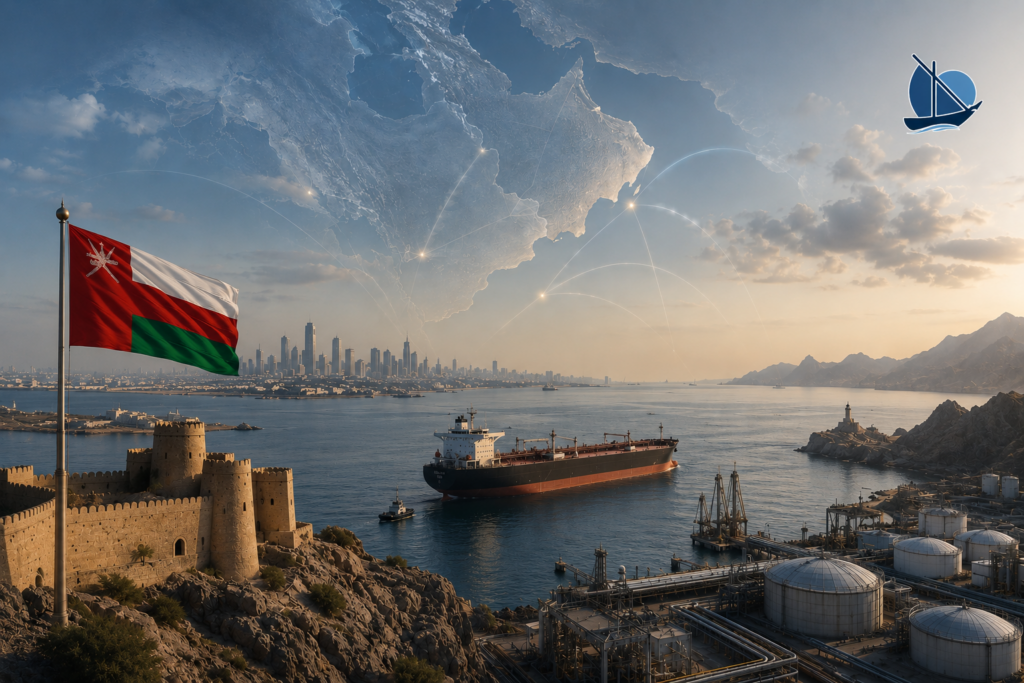
The U.S.-Israeli war against Iran and the resulting closure of the Strait of Hormuz drove oil prices sharply higher. Due to Oman’s geographic advantages, exports and public revenues increased significantly. This produced positive fiscal and trade outcomes. The state budget shifted from deficit to surplus, while the current account also improved. As a result, reserve assets expanded, public debt declined, and foreign investment conditions strengthened.
The Iran war demonstrated the extent to which political and economic relations shape military dynamics, while also highlighting the strategic importance of geography in determining economic outcomes. The strength of Omani-Iranian relations, combined with Muscat’s central role in international mediation with Tehran, made Oman the Gulf state least exposed to Iranian military attacks compared with the rest of the Gulf region.
Iran launched 19 drones against Oman targeting several locations, including the ports of Duqm and Salalah. By comparison, the United Arab Emirates was hit by 521 ballistic missiles and 2,141 drones.
At the same time, Oman’s geographic location generated substantial economic advantages. The Sultanate lies in the southeastern corner of the Arabian Peninsula. It borders the Gulf of Oman to the northeast and the Arabian Sea to the southeast, while sharing land borders with Saudi Arabia, the United Arab Emirates, and Yemen. The Strait of Hormuz lies to the north along the Omani Musandam Peninsula.
This geography plays a decisive role in Oman’s external trade structure. Maritime gateways on the Gulf of Oman and the Arabian Sea account for the largest share of Omani trade flows, followed by land crossings and then air transport routes.
The negative impact of the Hormuz closure has remained limited in Oman compared with the rest of the Gulf for two principal reasons: the location of Omani ports outside the strait and the continued operation of overland trade routes. With the exception of Khasab port in Musandam, all major Omani ports are situated outside the Strait of Hormuz, including Sohar, Duqm, and Salalah. In 2025, more than 3,000 vessels carrying goods worth 7.389 billion Omani rials docked at Sohar port alone, representing approximately 43 percent of Oman’s total imports.
The second reason concerns the importance of overland trade between Oman and the United Arab Emirates. The UAE is Oman’s second-largest export destination and its leading source of imports. Around 85.5 percent of Omani exports to the UAE and 75.5 percent of imports from the UAE are transported by land. Nevertheless, the majority of Oman’s trade with Saudi Arabia, Kuwait, Bahrain, Qatar, and Iraq still passes through the Strait of Hormuz.
Regarding the legal framework governing the strait, the relevant reference point remains the 1982 United Nations Convention on the Law of the Sea, which regulates issues related to sovereignty and maritime rights. The convention guarantees freedom of navigation for civilian and military vessels through international straits. Under the transit passage regime, coastal states are not permitted to block maritime traffic or impose transit fees on passing ships.
A total of 166 states have ratified the convention, including Oman, Saudi Arabia, Qatar, Bahrain, Kuwait, and Iraq. Following the outbreak of the U.S.-Israeli war against Iran, Tehran announced the closure of the Strait of Hormuz and imposed transit fees on passing vessels based on cargo volume at a rate of one dollar per barrel of oil. Iran also argued that Oman had the right to collect transit fees because of its geographic position on the strait.
The Iranian position is based on the principle of coastal state sovereignty. Tehran signed the convention but never ratified it, and declared that revenues generated from transit fees would be allocated to postwar reconstruction. Oman, by contrast, formally reaffirmed its commitment to the convention, emphasized freedom of navigation, and rejected the imposition of transit fees on vessels crossing the strait.
It is important to note that non-ratification of the convention does not necessarily imply opposition to freedom of navigation in the Strait of Hormuz. The United States, for example, supports freedom of navigation despite not ratifying the convention. The same applies to the United Arab Emirates. The International Maritime Organization also called for preserving free navigation in the strait without interference from coastal states. Nevertheless, the UN Security Council failed to adopt a resolution authorizing the reopening of the strait by force.
Rising Oil Prices and Expanding Revenues
Oman is an oil-producing state but not a member of OPEC. Following the UAE’s recent withdrawal, Saudi Arabia and Kuwait are now the only Gulf Cooperation Council members remaining in the organization. Oman, however, remains part of OPEC+, meaning that it adheres to collective production decisions, particularly those related to output quotas. Bahrain follows a similar model.
Oman’s proven oil reserves stand at approximately five billion barrels, equivalent to Sudan’s reserves and only 1.8 percent of Saudi Arabia’s reserves. According to Oman’s National Centre for Statistics and Information, current oil production stands at 1.052 million barrels per day. Around 196,000 barrels per day are allocated for domestic consumption, while 856,000 barrels per day of crude oil and petroleum products are exported.
Omani oil exports have limited influence on global energy markets compared with producers such as Saudi Arabia, Iraq, and Iran. Oman accounts for only 0.8 percent of global oil consumption. Nevertheless, these exports remain strategically important under current wartime conditions characterized by tightening supply. Oman is also an exporter of natural gas and liquefied natural gas, and these exports continue to grow annually. Gas production increased from 152.3 million cubic meters per day in 2025 to 155.5 million cubic meters per day in 2026.
The Strait of Hormuz remains one of the most critical arteries of global oil trade. Approximately 20 million barrels per day transit through the strait, equivalent to around 20 percent of global oil consumption. Under such conditions, the closure of Hormuz inevitably pushed crude prices upward.
In practical terms, however, the global market was not deprived of the full 20 million barrels per day for three reasons. The first was the availability of alternative export routes. Saudi Arabia continued exporting oil through its east-west pipeline linking the eastern oil fields to the Red Sea port of Yanbu. A significant share of Emirati oil was also redirected from Habshan in Abu Dhabi to Fujairah on the Gulf of Oman.
The second factor was increased oil production by non-Gulf producers, particularly Russia and Venezuela. The third was the release of strategic petroleum reserves by industrialized states in order to stabilize global markets.
Despite these mitigating factors, Brent crude prices rose from $71.4 per barrel on February 27, 2026, one day before the outbreak of the war, to $92.2 on March 6 and $109.2 by May 15. Revenue calculations can therefore be derived from export volumes and prevailing prices.
This method, however, does not accurately capture Omani revenues because Omani crude exports are priced through monthly futures contracts. Monthly revenues must therefore be estimated using contract prices and export volumes of 856,000 barrels per day.
In March, futures contracts for Omani crude averaged $62.2 per barrel, well below Brent prices. As a result, the war did not immediately increase Omani revenues. On the contrary, Oman incurred financial losses linked to futures pricing. In April, the Omani crude price rose modestly to $68 per barrel. Revenues reached approximately $1.746 billion, calculated as follows: $68 per barrel multiplied by 856,000 barrels per day over 30 days. Revenues therefore remained broadly similar to the previous month.
In May, however, Omani crude prices surged to $124.4 per barrel, exceeding average Brent prices. Under the same formula, May revenues reached approximately $3.301 billion, representing an increase of 89 percent compared with April. In June 2026, Omani crude prices are expected to average $104.7 per barrel, generating revenues of approximately $2.688 billion. In July 2026, prices are projected to reach $106 per barrel, producing revenues estimated at $2.812 billion.
The 2026 Budget: From Deficit to Surplus
Oman’s 2026 budget projected total revenues of 11.447 billion Omani rials, including oil revenues estimated at 5.752 billion rials. These calculations were based on a benchmark oil price of $60 per barrel.
Oil revenues account for roughly half of total state income, underscoring the central role of hydrocarbons in Oman’s public finances. The importance becomes even greater when gas revenues are included. Total public expenditure was estimated at 11.977 billion rials, leaving the budget with a projected deficit of 530 million rials.
Naturally, the deficit expands when futures prices fall below the benchmark level. Conversely, higher futures prices reduce the deficit and can transform the budget into surplus.
Under the budget law, the deficit was to be financed through two sources. The first involved withdrawing 400 million rials from the central bank’s reserves. The second relied on domestic and external borrowing to cover the remaining 130 million rials. Under this framework, deficits reduce reserve assets, weaken state financial capacity, and increase public debt.
Actual oil revenues, however, greatly exceeded official projections. Based on the calculations above, oil revenues for May, June, and July 2026 are expected to reach 3.394 billion rials, compared with budget estimates of only 1.928 billion rials for the same period. Assuming oil prices return after July to their February 2026 levels, the budget would shift by year’s end from a deficit of 530 million rials to a surplus of approximately 936 million rials.
Another factor must nevertheless be taken into account: rising Omani military expenditures resulting from Iranian attacks. Military spending is already high by regional standards. The current budget allocates 3.160 billion rials to defense, equivalent to 25.3 percent of total public expenditure. Overall, the war and the closure of the Strait of Hormuz increased Oman’s domestic revenues while simultaneously strengthening its external financial position.
External Finances Improve
In 2025, the International Monetary Fund published its Article IV consultation forecasts for Oman’s current account balance in 2026. The projections anticipated a decline in oil and gas exports from $38.6 billion in 2025 to $36 billion in 2026. Total exports were therefore expected to contract. As a result, the current account deficit was projected to widen from 1.2 percent of GDP in 2025 to 3.4 percent in 2026. Rising external deficits were also expected to reduce foreign reserves from $19.3 billion in 2025 to $17.8 billion in 2026.
The war against Iran and the closure of the Strait of Hormuz, however, drove Omani oil prices sharply higher beginning in May 2026. Export revenues consequently increased and are likely to continue rising as long as the closure persists. Under these conditions, the IMF forecasts issued before the war no longer reflect current realities and require substantial revision.
As in the case of the state budget, the current account is therefore expected to shift from deficit to surplus. Foreign reserves would increase and public debt levels would decline. The scale of this transformation will depend on the pricing of future oil contracts concluded by Oman in the coming months. The war has also contributed to rising foreign investment, particularly in the energy sector.
Rising Foreign Investment
Foreign direct investment in Oman has increased substantially over the past decade. Total FDI rose from 7.2 billion rials in 2016 to 31.3 billion rials in 2025, representing an average annual increase of 37.2 percent. Energy dominates the investment landscape. Foreign investment in oil and natural gas reached 25.4 billion rials, accounting for 81.1 percent of total FDI. More than half of these investments originate from the United Kingdom, followed by the United States, Kuwait, and China.
One of the most important British companies operating in Oman is BP, which signed a 30-year agreement in 2013 worth $16 billion to develop unconventional natural gas resources in the Khazzan field. The armed conflict in the Gulf region and the closure of the Strait of Hormuz have increased demand for Omani oil due to the country’s strategic geographic position. This has encouraged greater foreign investment in Omani energy fields. In April 2026, the Ministry of Energy and Minerals offered five new oil and gas concession areas, intensifying competition among international companies seeking contracts in the Sultanate.
Oman is expected to advance its strategy aimed at improving foreign investment in the energy sector despite some structural challenges related to production costs. Specialists consider Omani oil fields geologically difficult compared with other Gulf producers. Extraction requires advanced technologies and substantial gas injection to produce heavy crude. Operating costs in Oman are estimated at approximately $10 per barrel, compared with $5 in Iran and Iraq and less than $4 in Saudi Arabia.
