

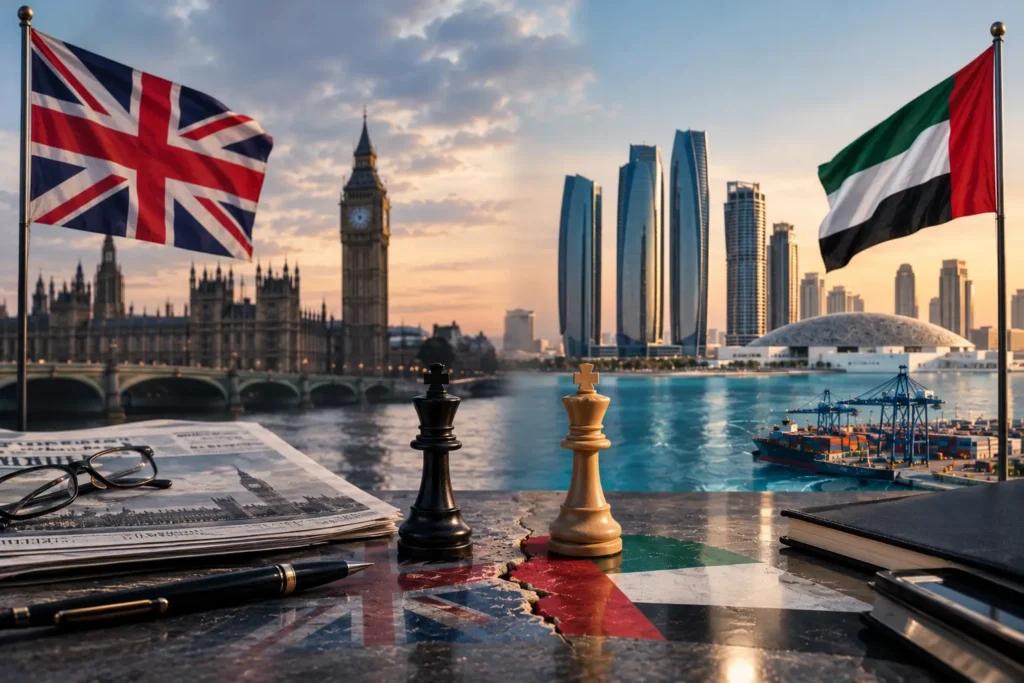
Relations between Britain and the United Arab Emirates need not reach the point of a diplomatic rupture for it to become clear that something is wrong. Britain’s historical role as a protecting power in the Gulf and its contribution to the establishment of the UAE federation in the early 1970s now seem a distant memory amid growing suspicions between the two countries. Finance, investment and the media, once signs of a close relationship, have become testing grounds for intentions and for what each side regards as interference in its internal affairs. What is unfolding between London and Abu Dhabi falls short of a crisis, but it is certainly more than a disagreement.
In early October, The Guardian published an extensive investigation into Sheikh Tahnoon bin Zayed, Deputy Ruler of Abu Dhabi and the UAE’s National Security Adviser. It drew comparisons with villains in James Bond films and used pointed language, some of which could be described as lacking decorum. It goes without saying that the British press is independent and that the government’s relations with other countries do not shield their officials from criticism in British newspapers. Nevertheless, the timing, tone, language and content of the investigation warrant closer examination.
The deeper problem lies in the two capitals’ differing understandings of the boundaries between the state and the public sphere. Abu Dhabi wants London to take its security concerns about political Islamist groups seriously. London, in turn, fears that accommodating Abu Dhabi and granting it special treatment could constrain the independence of British institutions. As each capital uses its instruments of soft power to exert pressure or signal displeasure, managing their disagreements through diplomatic courtesies becomes increasingly difficult.
The attempted takeover of The Telegraph offers a clear example. On 16 October, British regulators’ reports were published concerning the bid by RedBird IMI, a majority Emirati-owned investment vehicle involving Emirati and American partners, to acquire the newspaper. The bid failed after Ofcom raised concerns that Emirati ownership could affect the accuracy of news reporting and freedom of expression. The regulator considered the investor’s ties to the UAE grounds for further scrutiny. The Emirati company rejected these conclusions, accusing Ofcom of conflating a commercial company with a sovereign state and disregarding the editorial independence safeguards it had offered.
In finance and business, Britain is keen to attract Gulf capital but prefers to attach conditions when investment reaches sensitive sectors. From London’s perspective, acquiring property in the capital cannot be equated with owning a newspaper that helps shape British public opinion. Britain wants Gulf money, subject to safeguards that protect state authority and curb the political influence such capital and investment might generate.
Since last December, suspicions in London have intensified as figures and parties on the British right have drawn closer to the UAE. In January, Nigel Farage visited Dubai, met government officials and sought donations for Reform UK from wealthy British residents there. For the Labour government, these developments warranted attention. There is no evidence that the Emirati government funds the party, but the repeated visits prompted debate and scrutiny within the British government and press.
The absence of evidence of Emirati funding has not erased the political impact of these emerging ties. This is particularly apparent when British and Arab politicians and social media influencers repeatedly promote Dubai and extol its standing, often linking that praise to London’s failures, economic decline and widespread street theft. London believes that this promotion of Dubai and disparagement of the British capital go beyond tourism and commercial advertising.
For its part, Abu Dhabi appears unimpressed by the Labour government and its domestic and foreign policies. It consequently regards the Conservatives and other groups on the British right as more receptive to its concerns about political Islamist groups that have been active in London since the 1970s. In practical terms, the UAE has restricted funding for its citizens’ postgraduate studies at British universities over concerns about Muslim Brotherhood influence on campuses. This was not a blanket ban on studying in Britain, but it extended the dispute into an area closely connected to the two countries’ social and educational ties.
From Abu Dhabi’s perspective, Britain’s continued engagement with Islamists has become difficult to understand or accept, particularly in the case of the Muslim Brotherhood, which the UAE designates as a terrorist organisation. Emirati demands go beyond pursuing individuals whom its authorities have determined to be involved in criminal activity. Abu Dhabi wants London to adopt a broader understanding of the threat posed by the organisation and its networks, both in Britain and abroad. London, however, firmly insists on handling security matters, including proscription and prosecution, through its own judicial and political system.
The political and diplomatic chill has not prevented Britain from helping defend Emirati airspace during the recent Gulf war, with British Typhoon squadrons operating to counter Iranian drones and missiles. On 8 March, approximately one week after the war began, Downing Street announced that British counter-drone advisers were working with Emirati military specialists. On 31 March, the Ministry of Defence reported that air missions had been flown over Qatar, Bahrain, Jordan and the UAE. Meanwhile, London remains one of the leading tourist destinations for Emirati citizens, who throng its streets during the summer months.
Despite the deterioration in the political atmosphere, the two countries share areas of political agreement, economic interests and military cooperation that are difficult to set aside. A British government factsheet published in March 2026 recorded the stock of Emirati foreign direct investment in the United Kingdom at approximately £7 billion at the end of 2024, compared with £4.2 billion in British direct investment in the UAE. These figures cover direct investment rather than the full range of assets, property holdings and financial portfolios, whose combined value is considerably greater. In a government answer to Parliament, bilateral trade was put at approximately £25 billion in 2025, while press reports estimated that around a quarter of a million British nationals lived in the UAE before the recent war. Behind these figures are businesses, families and professional interests that make any deterioration in relations costly. Its effects would extend across a broad community of citizens from both countries, well beyond the two governments.
Despite reports that the UAE postponed an official visit to London by President Sheikh Mohamed bin Zayed Al Nahyan scheduled for March, high-level meetings have continued. These included the Emirati president’s meeting with the British prime minister in Abu Dhabi in April.
The most likely scenario is that relations between Britain and the UAE will continue to function economically, but with diminished political trust. Yet their ability to withstand this chill is no reason to accept it as a lasting condition. Accumulating suspicions between the two capitals now colour every regulatory decision, financial investment and press report. This state of affairs comes close to an official declaration of hostility.
Both sides need a regular channel for addressing their disagreements. The anticipated high-level Emirati visit to Britain could help, but its value will depend on what it can resolve behind closed doors, rather than the displays of warmth and esteem captured on camera. Their real interest lies in each finding opportunities to benefit from the other’s strengths, while ensuring that their differences remain manageable and are handled with sound judgement.
