

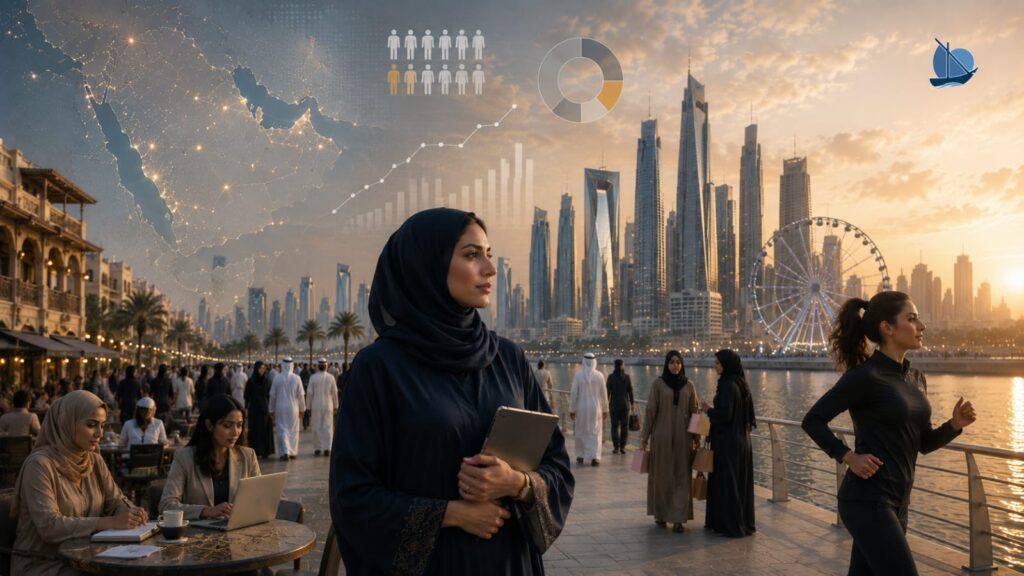
More than at any previous moment, Gulf women today occupy a highly visible place in public life. Their presence extends beyond universities and labor markets into tourism campaigns, sports seasons, entertainment industries, and digital platforms.
Saudi Arabia recently announced that it welcomed nearly 123 million tourists in 2025. Dubai recorded approximately 19.59 million international visitors during the same year, while Qatar concluded 2024 with more than 5.07 million visitors and nearly 10 million hotel nights. These figures help explain why “social openness” has become embedded within the Gulf’s regional competition model.
This transformation does not necessarily signal the disappearance of restrictions. It reflects a change in their nature. Direct social control has increasingly given way to pressures linked to image management, digital visibility, and the ambiguous conditions surrounding new forms of employment associated with entertainment, festivals, and social media economies.
As Gulf capitals compete for tourists, global sporting events, international conferences, and foreign investment, the image of society itself ceases to be a purely domestic matter. It becomes part of how the state presents itself to the outside world. Official economic strategies make this clear. Saudi Arabia aims to raise tourism’s contribution to GDP to around 10 percent by 2030. The United Arab Emirates links its tourism strategy to attracting AED 100 billion in new investments while increasing the sector’s contribution to AED 450 billion. Qatar has openly declared its intention to raise tourism’s contribution to between 10 and 12 percent of GDP by 2030.
Within these strategies, the image of Gulf women increasingly appears as part of the new Gulf city: professional, athletic, influential, socially visible, and integrated into an economy seeking to project modernity, stability, and attractiveness. The central question is no longer whether women are present in public life, but how their role is being redefined within the emerging relationship between state, market, and identity.
From Guardianship to the Market
The Gulf’s transformation has not been a simple transition from prohibition to freedom. It has been a transition from one form of regulation to another.
In earlier decades, conservative Gulf states regulated women’s visibility through family structures, social norms, and separation between social spaces. These controls extended into schools, universities, and workplaces. Today, however, the market demands a different type of visibility. It favors women who are publicly present, media-friendly, and compatible with the needs of tourism, entertainment, hospitality, sports, and service economies.
This is not merely a theoretical observation. Official Saudi, Emirati, and Qatari development plans place culture, entertainment, sports, and urban lifestyle at the center of economic growth strategies. Within such a model, women’s visibility becomes part of the broader public display through which states market themselves.
Saudi Vision 2030 explicitly connects economic diversification, tourism, sports, and women’s participation in the labor force. The Kingdom’s latest annual report announced that women’s labor force participation reached 36 percent, surpassing the original Vision target. In the UAE, narratives of women’s empowerment increasingly accompany official messaging about global competitiveness, innovation, tourism, and international investment. In Qatar, the post-World Cup strategy relies heavily on sports diplomacy, major events, and international conferences to consolidate the country’s regional standing.
In all three cases, women have become part of the architecture through which states engineer international perception. Recent analyses of Gulf soft power increasingly point to tourism, sports, and global events as tools through which Gulf governments seek to reshape their international image.
What Drives This Transformation?
The first driver is economic.
Saudi Arabia’s Vision 2030 annual report states that non-oil activities accounted for 55 percent of GDP in 2025. Tourism’s direct contribution reached approximately 5 percent of GDP in 2024, with a publicly stated target of 10 percent by 2030.
In the UAE, non-oil sectors accounted for 74.6 percent of real GDP during the first nine months of 2024. Preliminary figures for the first nine months of 2025 indicate that the share rose further to 77.3 percent.
In Qatar, tourism authorities announced that the sector contributed approximately QAR 55 billion to GDP during 2024, equivalent to around 8 percent of the national economy.
These numbers illustrate a broader reality: Gulf states are no longer relying exclusively on hydrocarbons as the primary engine of growth. They require marketable cities, service-based economies, globally connected urban centers, and social environments capable of attracting investment, visitors, and international talent.
The second driver is competition.
The Gulf’s rivalry no longer revolves solely around logistics, energy, or foreign direct investment. It increasingly centers on which state appears more open, more modern, more stable, and more capable of hosting global events successfully. The language of “impressing the world” has become a recurring theme across Gulf official discourse surrounding international exhibitions, sporting tournaments, and entertainment seasons.
In this environment, social openness itself becomes an economic asset. The new image of Gulf women functions as visual proof of this transformation.
Soft Power and the Politics of Image
This new social formula operates through an interconnected network of tools. Fashion provides cities with a modern visual language. Sports create global visibility. Entertainment reduces the rigidity historically associated with Gulf societies. Influencers and social media personalities translate state-led transformation into everyday digital content designed for consumption and circulation.
Culture in this context is no longer a peripheral matter. It functions as a form of soft governance.
Recent studies on Gulf soft power suggest that sports tournaments, cultural festivals, heritage tourism, and international conferences are not simply profitable sectors. They are mechanisms through which Gulf states seek to reshape global perceptions of themselves.
As women enter these sectors as professionals, influencers, public figures, athletes, or symbolic representations of modernity, they also become part of state-led public diplomacy. This does not negate the very real gains many women have achieved in education, employment, and public participation. However, it places these gains within a broader political and economic framework in which society itself becomes part of the state’s message to the world.
The common denominator across the Gulf is increasingly clear: women are no longer marginal to the symbolic economy of the region. They have become central to it. Yet this centrality remains shaped by state priorities, strategic planning, and market demands simultaneously.
The New Restrictions
The central issue is not whether some traditional restrictions have declined. The more important issue is that new forms of pressure have emerged alongside them.
Women entering the Gulf’s new public sphere are not only expected to demonstrate competence. They are also expected to embody a marketable image. Appearance matters. Language matters. Digital presence matters. Visibility itself becomes part of professional and social value.
The region’s emerging economies rely heavily on tourism, services, retail, media, and flexible labor structures. These sectors may create rapid opportunities, but they do not necessarily provide the long-term stability once associated with state employment.
As a result, the debate extends beyond the traditional binary of conservatism versus openness. The deeper question concerns the nature of integration itself. Are Gulf women entering an economy that grants genuine independence, or are they entering a system that demands continuous visibility while offering reduced security?
This question becomes even more significant when viewed within the wider regional context. Women’s labor force participation across the Middle East and North Africa remained around 19 percent in 2023. Gulf progress therefore continues to unfold within a region still shaped by structural inequality, care burdens, and uneven access to opportunity.
An Open Conclusion
The issue is not whether Gulf women have become “liberated” in an absolute sense. That is ultimately a moral and ideological question more than an analytical one.
The more relevant question is this: what has changed in the political and economic function of women’s public image within Gulf societies?
The answer appears to be that women have moved from a position historically managed through the language of social protection and conservatism to one increasingly shaped by competitiveness, attractiveness, quality of life, and soft power.
This transformation has undoubtedly opened new opportunities in education, employment, sports, and public participation. At the same time, it has produced new pressures. Women are increasingly expected to remain productive, visible, persuasive, adaptable, and permanently prepared for public performance within an economy driven by image, branding, and continuous exposure.
