

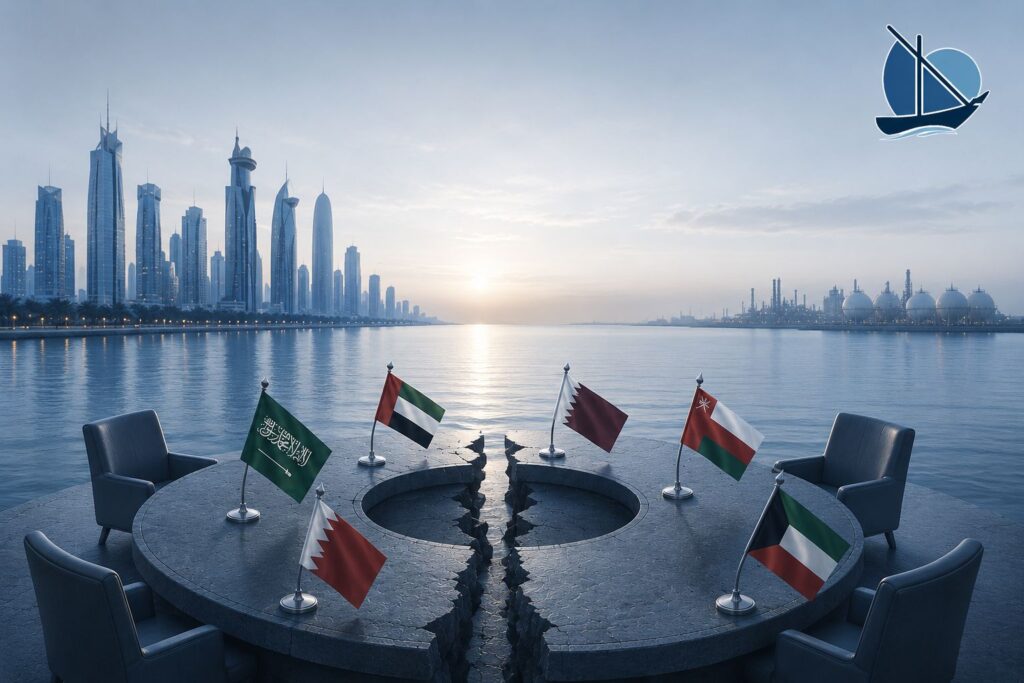
Since the outbreak of the U.S.-Israeli war against Iran on February 28, 2026, the familiar language of Gulf diplomacy has struggled to conceal the scale of the region’s growing divisions. What began as large-scale strikes against Iran quickly expanded into the Gulf through missile and drone attacks, placing the Gulf Cooperation Council (GCC) under one of the most severe tests in its history. The crisis has evolved beyond a military confrontation. It now challenges the Council’s ability to function as a unified political and security framework at a moment when the territories, ports, airports, and energy infrastructure of its member states are under direct pressure.
The first weeks of the war demonstrated that the Gulf did not enter the crisis as a coherent bloc. The United Arab Emirates and Bahrain adopted a more confrontational posture toward Iran, shaped by the intensity of the attacks they faced, their deep security ties with the United States, and their place within the regional normalization framework with Israel. Saudi Arabia appeared more cautious, seeking to shield its economy, infrastructure, and long-term development projects from a prolonged regional escalation. Qatar maintained its emphasis on mediation and de-escalation, while Oman adhered to its traditional diplomatic approach of preserving open channels with Tehran. These differences were not tactical disagreements over crisis management. They reflected years of diverging strategic perceptions regarding Iran, the United States, Israel, and the regional role of each Gulf state.
Saudi Arabia and the UAE: A Deepening Strategic Rift
The consultative summit held in Jeddah on April 28, 2026, was expected to serve as a moment of political repair for the GCC. The final statement condemned the Iranian attacks and reaffirmed the right of member states to defend themselves individually or collectively. Yet the summit exposed the limits of Gulf consensus more than it demonstrated unity. No agreement emerged on a joint military command structure, coordinated use of foreign military bases, a common negotiating position toward Tehran, or a shared vision for maritime security in the Strait of Hormuz. Oman’s absence and the UAE’s lower-level representation highlighted the scale of the divisions within the Council.
On the same day, the UAE’s decision to withdraw from OPEC and OPEC+ gave the Saudi-Emirati dispute a direct economic dimension. The move represented a departure from one of the principal arenas through which Saudi Arabia had exercised international influence for decades. Reuters described the decision as a blow to the organization and as evidence of widening fractures between Abu Dhabi and Riyadh at a moment when the Iran war had already exposed deep tensions inside the Gulf order. UAE Energy Minister Suhail Al Mazrouei later stated that the decision was not directed against any state and reflected the country’s desire to increase production without external constraints in response to investor interests and global demand. The message was clear: Abu Dhabi no longer sees itself bound by the Saudi approach to managing global energy policy.
For years, Riyadh and Abu Dhabi have operated along overlapping yet competing strategic trajectories. Both seek to attract capital, technology, multinational corporations, ports, and regional decision-making centers. Saudi Arabia aims to leverage its demographic, geographic, and religious weight to emerge as the dominant economic and political center of the Gulf. The UAE seeks to preserve a model built on speed, openness, logistics, finance, and global connectivity. The war intensified this rivalry. The disruption of Hormuz threatened both economic models while pushing each state toward a different strategic reading of the conflict. Riyadh leaned toward containment and de-escalation. Abu Dhabi favored rapid deterrence and a forceful response designed to prevent Iran from turning Gulf security into a permanent hostage to regional escalation.
Security assessments circulating within Gulf military circles also pointed to a decline in operational coordination between the two countries during the interception of Iranian drones and missiles, including reduced cooperation in radar data-sharing and early-warning systems. This deterioration appears to have contributed to the successful penetration of some Iranian projectiles into sensitive targets in both states.
Doha and Abu Dhabi: Fragile Reconciliation
Relations between Qatar and the UAE appear less stable than the intensive exchange of official visits between their leaderships suggests. The Al-Ula agreement of 2021 formally ended the Gulf crisis, yet the roots of the dispute remain active. Differences over political Islam, Turkey, Libya, the Horn of Africa, media influence, and proxy-driven information campaigns in Western capitals continue to shape relations beneath the surface of reconciliation.
The war gave these tensions a new strategic meaning. Qatar refused to abandon its role as a mediator and maintained its practical partnership with Washington while avoiding any transformation into a political platform for escalation against Tehran. The UAE viewed the Iranian threat through a different lens. From Abu Dhabi’s perspective, prolonged de-escalation grants Tehran additional time to rebuild its capabilities, while the absence of a decisive response leaves Gulf security vulnerable to coercion. The gap between the two approaches cannot be bridged through symbolic diplomatic statements or displays of solidarity.
Bahrain occupies one of the region’s most sensitive positions. Manama joined the Abraham Accords alongside the UAE and continues to carry the legacy of sectarian tensions and accusations of Iranian interference. As a result, Bahrain’s strategic reading of Iran aligns more closely with Abu Dhabi’s, making it more willing to support a harder line toward Tehran. At the same time, this alignment places Bahrain in a delicate position with Saudi Arabia, which remains its principal security guarantor and currently favors limiting escalation rather than expanding it. No public evidence yet points to a direct Saudi-Bahraini crisis. However, Bahrain’s position between Saudi strategic restraint and Emirati assertiveness could eventually turn it into an internal friction point within the GCC if the gap between Riyadh and Abu Dhabi continues to widen.
Oman: A Different Strategic Logic
Oman represents the other side of the Gulf crisis. Muscat built its regional strategy around caution, mediation, and distance from rigid alignments. The war has made neutrality increasingly costly. Oman condemned attacks on its territory and the territory of neighboring states while strongly opposing the war itself and maintaining communication with Iran due to geography, history, and the shared management of the Strait of Hormuz. Official Omani statements reaffirmed support for Gulf security, yet Muscat shows no willingness to abandon its traditional role as a negotiating channel with Tehran. Several Gulf capitals increasingly view this positioning as closer to Iran than to a unified Gulf posture.
The growing tension between the UAE and Oman extends beyond media exchanges or temporary disagreements. Its roots lie in historical disputes, the Yemen file, maritime geography, ports, the Emirati normalization track with Israel, and Omani concerns over the militarization of Hormuz. The more Abu Dhabi gravitates toward a deterrence-based posture against Iran, the stronger Muscat’s concern that its security environment is becoming subordinate to strategic equations it does not control. The more Oman insists on diplomacy and de-escalation, the greater the frustration in Abu Dhabi. The dispute is no longer about diplomatic language. It concerns fundamentally different definitions of security itself.
A Fragmented Gulf Order
The Gulf crisis is no longer confined to a single dispute. In 2017, the rupture centered on Qatar. Today, tensions are spread across multiple fronts: Saudi Arabia and the UAE over energy policy, Yemen, and regional leadership; the UAE and Qatar over political Islam, mediation, and influence; the UAE and Oman over Iran, Yemen, maritime security, and strategic waterways; Bahrain balancing Saudi protection with strategic alignment alongside the UAE; and Kuwait navigating between domestic caution and the pressures of Gulf solidarity.
These disputes cannot be resolved through a single reconciliation summit because they are not rooted in a limited list of demands. They stem from competing visions of the regional order itself. The issue of relations with Israel adds another layer of complexity. The UAE and Bahrain normalized relations with Israel in 2020. Saudi Arabia remains outside a formal agreement while preserving unofficial channels and political conditions. Qatar, Oman, and Kuwait remain more cautious, though each for different reasons.
Discussion of a potential rupture within the GCC is no longer political exaggeration. This does not necessarily mean the Council is approaching imminent collapse. Economic, political, and security interdependence still makes a full break costly for all parties. Yet the GCC could drift into a new reality defined by undeclared estrangement, partnership without trust, meetings without decisions, and security coordination managed more through Washington than through Gulf institutions themselves.
Three possible trajectories now confront the Gulf states. The first is limited restoration through freezing disputes and launching a serious internal dialogue aimed at managing disagreements gradually. The second is the management of division, where the GCC survives as a largely ceremonial umbrella under which smaller alignments operate according to the issue at hand. The third is escalation. Such a scenario could emerge alongside renewed military confrontation, a major media or security dispute, or unilateral arrangements with Washington, Tel Aviv, or Tehran that another Gulf state perceives as threatening its own security.
The war did not create Gulf divisions. It deepened them and stripped away the diplomatic cover that once concealed them. The GCC now faces a harsh moment of strategic redefinition concerning its alliances, regional role, and ability to function as a coherent bloc. If the six capitals fail to overcome the current crisis, the Council may continue to exist institutionally while losing its capacity to produce unified policy during the moments for which it was originally established. Between the survival of the GCC as a structure and the erosion of its strategic effectiveness, the Gulf is moving toward its most dangerous phase since the Council’s founding.
