
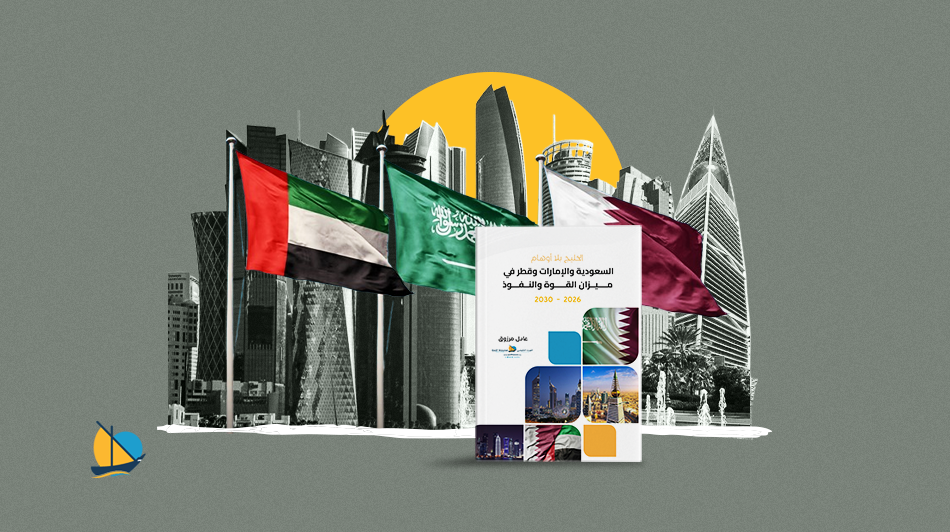
The Gulf Without Illusions: Power and Competition among Saudi Arabia, the UAE and Qatar 2026-2030

Executive Summary
The Gulf is no longer a space governed by traditional understandings or by the illusion of permanent harmony. Over the past decade, relations among Saudi Arabia, the United Arab Emirates, and Qatar have entered a new phase in which policies are shaped by calculations of power, interest, and survival rather than by notions of fraternity or shared history.
This report advances a central premise: the Saudi–Emirati–Qatari triangle has become one of the principal determinants of stability and tension in the Gulf region. The behavior of these states is increasingly governed by the rules of hard realism within a regional and international environment marked by uncertainty.
The report demonstrates that, despite its continuity and past achievements, the Gulf Cooperation Council has failed to evolve into a binding framework for collective behavior. Instead, it is employed selectively when interests converge and bypassed when they diverge. Intra-Gulf disputes are no longer episodic incidents or temporary misunderstandings, but rather expressions of structural shifts in how each state perceives its role, status, and limits of regional influence.
At the bilateral level, the report shows that the Saudi–Emirati alliance, despite its apparent solidity, conceals a growing structural competition, particularly in the domains of economy, energy, and regional influence. Tactical cooperation persists as a rational option to avoid open confrontation, but it does not negate underlying rivalry.
Saudi–Qatari relations are managed through a logic of “cautious coexistence” following the 2017 crisis. Political channels have been restored without the return of deep trust, as each side continues to safeguard its decision-making autonomy and instruments of influence. By contrast, Emirati–Qatari relations can be described as a “cold peace,” where surface stability masks ongoing competition over regional roles, mediation efforts, and media and international influence.
The report further examines expected global transformations through 2030, including the management of conflict with Iran, the future of the Palestinian cause after the Gaza war, the repositioning of the United States, the rise of China, and shifts in energy and technology markets. These developments are likely to serve as practical tests that reveal the depth of Gulf divergence.
Between a cautious Saudi approach focused on risk reduction and the protection of its development project, an Emirati pragmatism that separates economic and political tracks, and a Qatari strategy centered on mediation and diversified partnerships, three adjacent Gulf visions of the world are taking shape rather than a single unifying outlook.
The report concludes that the most probable scenario in the coming years is one of “managed competition”: selective cooperation, calibrated rivalry, and controlled disputes without reaching comprehensive resolutions. Neither automatic Gulf unity nor a complete rupture appears likely. What governs the landscape is a cold, interest-based rationality that redefines Gulf relations on a state-by-state basis within a regional system that rewards power and reach rather than good intentions.
Introduction
Relations among Gulf states can no longer be understood as a natural extension of a shared identity or as an automatic outcome of geographic proximity. These states have become an open arena for redefining their nature, status, and limits of influence. Over the past decade, interactions among Saudi Arabia, the United Arab Emirates, and Qatar have shifted from managing differences within a collective framework to managing them outside it, placing that very framework under strain and testing its capacity for accommodation and regulation.
This transformation was not the result of a sudden rupture, but rather of an accumulative process shaped by intersecting ambitions, shifts in regional power balances, and changing priorities among international patrons. As the weight of wealth, economic portfolios, energy, security, and diplomatic influence has grown, each Gulf state has come to view its surroundings not only through the lens of external threats, but also through competition with its closest partners.
Within this context, the function of the Gulf Cooperation Council has receded from that of a political organizing instrument to a flexible coordination framework. Its mechanisms are activated when interests align and circumvented when calculations diverge. The Council no longer serves as a forum for producing binding decisions, but rather as a space for managing differences and preventing their escalation into open conflict, without the capacity to generate a sustainable collective vision.
This report proceeds from this reality as a structural feature of the contemporary Gulf system rather than as a temporary malfunction. Saudi Arabia, the United Arab Emirates, and Qatar operate within a regional environment characterized by fluidity and uncertainty, prompting each state to reassess its tools and alliances through precise calculations in which sovereignty, internal stability, and the expansion of influence take precedence over other considerations.
The report does not seek to describe Gulf relations through idealized assumptions, but through an examination of their actual logic as manifested in the political, economic, and security behavior of the three states. It is grounded in the premise that understanding the future of the Gulf requires first understanding how competition is managed, rather than assuming a unity that now exists largely in official rhetoric.
In practice, relations among Gulf states have long been governed by the principle of absolute national sovereignty, meaning that each state ultimately retains the right to act according to its own calculations to secure its interests and safety. It is true that Saudi Arabia, since the establishment of the Gulf Cooperation Council in 1981, has played the role of the senior partner and guiding state in shaping the foreign policies of member states. This, however, does not negate the fact that differentiation among members has accompanied the Council since its inception.
The difference lies in the fact that Oman, which has long pursued a distinct foreign policy, did not manage its divergence in a confrontational manner vis-à-vis Saudi Arabia. This pattern changed with the rise of Qatar and the United Arab Emirates, both of which have combined differentiation with direct competition with Riyadh through alternative projects and across multiple contexts.
This state of strategic ambiguity is evident in the rapid formation and dissolution of Gulf alliances in response to shifting interests and challenges, as well as in the inability to sustain strict collective commitment to unified policies. Despite frequent political and media discourse emphasizing “Gulf brotherhood” and “unity of destiny,” events reveal that mutual trust remains limited when interests collide. The Gulf crisis (2017–2021) and the indirect Saudi–Emirati confrontation at Yemen’s Mukalla port in 2025 stand as clear illustrations of this reality.
During the Gulf crisis, Saudi Arabia and the United Arab Emirates acted decisively to isolate Qatar based on the perception that Doha’s foreign policy threatened their interests or diminished their influence. Similarly, in the Saudi–Emirati confrontation, Riyadh viewed Emirati policies as harmful to its interests and national security. In both cases, Qatar and the UAE advanced alternative perspectives, arguing that their differentiated policies did not constitute hostility toward Saudi Arabia but rather efforts to secure their own national interests.
Within the same context, the three states are engaged in an arms buildup marked by rising military expenditures and expanded arsenals. This trend does not appear to be integrated within a collective defense framework aimed at protecting the Gulf as a whole. Instead, it can be understood, in part, as a consequence of limited trust among the states themselves, as each seeks either qualitative superiority or, at minimum, a strategic balance vis-à-vis the others.
Saudi Arabia, by virtue of its demographic and geographic weight and its direct exposure to the Iranian threat, views itself as a predominant regional power and is keen to prevent any imbalance that might favor smaller neighbors capable of challenging its position. The United Arab Emirates, despite its limited population size, has adopted an activist foreign policy to maximize its role and secure its interests independently of full reliance on the Saudi umbrella. Qatar, following the experience of 2017, has come to recognize the cost of independent decision-making and has therefore diversified its security partnerships to avoid dependence on any single regional actor.
These military dynamics, combined with competition over influence, the balancing of extra-regional alliances, and caution in intra-Gulf cooperation, underscore the reality that the three states act as rational units within a volatile and suspicion-laden regional environment. They manage their relations according to a logic of power and interest, in which shared history or identity is insufficient to guarantee full coordination when strategic calculations diverge. Recognizing this logic is essential as a starting point for analysis and for deriving meaningful conclusions.
Saudi Arabia and the United Arab Emirates: Strategic Alliance or Structural Rivalry?
For decades, relations between Riyadh and Abu Dhabi appeared to constitute a solid pillar of the Gulf order. Saudi Arabia and the United Arab Emirates cooperated across multiple regional files, from countering Iranian influence and coordinating in arenas such as Bahrain during the 2011 unrest, to jointly leading the military coalition in Yemen in 2015, and aligning against currents of political Islam.
This convergence reached its apex during the 2013 Egypt crisis, when both states played a decisive role in the removal of the Muslim Brotherhood from power, and again in their unified stance during the 2017 boycott of Qatar. Such a record of strategic alignment created the impression that the two countries were natural partners, bound by an identical worldview and an unassailable level of mutual trust.
Yet this alliance concealed a rising structural rivalry. Over time, it became clear that Saudi Arabia and the UAE, as economic and political powers, harbor regional ambitions that do not fully converge over the medium and long term. Beneath the surface of declared coordination, divergences in interests and priorities began to emerge.
On the economic front, Saudi Arabia launched its ambitious Vision 2030 program to diversify its economy and reduce dependence on oil, with the explicit aim of transforming the Kingdom into a major hub for global investment and multinational corporations. To this end, Riyadh adopted assertive policies, including the requirement that international companies seeking Saudi government contracts relocate their regional headquarters to the Kingdom by 2024. From the Emirati perspective, these measures directly encroached on the UAE’s economic model. When Saudi Arabia announced the launch of a new national carrier backed by tens of billions of dollars, the initiative was widely perceived as a direct competitor to the UAE’s flagship airlines—Emirates and Etihad.
Riyadh went further by introducing new trade restrictions that reduced the preferential treatment of goods originating from free trade zones, a cornerstone of the Emirati economy. Certain products were excluded with the explicit aim of curtailing advantages enjoyed by the UAE following its 2020 normalization agreements with Israel.
These Saudi steps were met with sensitivity in Abu Dhabi, which viewed them as a challenge to its position as the region’s leading financial and logistics hub. The UAE, having been an early mover in economic diversification and investment attraction over the past two decades, has little incentive to relinquish its regional primacy in aviation, tourism, and logistics. In this light, the rare dispute within OPEC+ in 2021 over oil production levels can be read as an indicator of intensifying competition. At the time, the UAE rejected a Saudi proposal to extend production cuts, arguing that it constrained its plans to increase output and imposed substantial economic losses following multibillion-dollar investments to expand capacity. Although the dispute was eventually resolved, it revealed a growing Emirati reluctance to accept Saudi dominance over oil policy decisions.
Geopolitically, particularly in Yemen, the divergence became more pronounced. After years of fighting alongside Saudi forces against the Houthis, the UAE adopted an independent course in the south. By 2019, it had withdrawn most of its troops and backed the formation of the Southern Transitional Council, which advocates southern secession, in order to preserve Emirati influence over strategic ports and coastlines. In practical terms, Abu Dhabi sought a tangible return on the billions of dollars spent and the loss of dozens of soldiers. This shift created a gap in objectives between the two countries, leaving Saudi Arabia to contend with a new reality that weakened the Yemeni government and strengthened Emirati-backed actors.
On relations with Israel, the UAE moved swiftly to full normalization in 2020, securing immediate economic and strategic gains. Saudi Arabia, by contrast, adopted a more cautious approach, refraining from formal normalization without significant political and security concessions, while limiting itself to discreet channels of communication with Tel Aviv. This divergence allowed Abu Dhabi to advance more rapidly in cultivating international favor, particularly in Washington, thereby placing implicit pressure on Riyadh, which grew wary of the UAE emerging as the preferred Gulf partner of the United States. Within this context, Gulf states are engaged in a competitive race to be recognized as Washington’s most indispensable regional ally.
The interaction of these factors reflects an underlying hegemonic dilemma. Significant gains by one party are increasingly interpreted by the other as relative losses in status and influence. Despite the fraternal rhetoric and the maintenance of a formal alliance through frequent high-level visits, competition has become a defining feature of Saudi–Emirati relations. This rivalry remains bounded by a governing pragmatism. Both leaderships recognize that open confrontation would be detrimental, particularly given persistent security challenges and the shared need for stability to attract foreign investment.
Accordingly, Saudi–Emirati relations are likely to continue combining tactical cooperation in certain files with strategic competition in others. This trajectory reflects the logic of structural realism guiding the behavior of both states: a situational partnership shaped by national interest calculations. While this does not preclude the possibility of managed friction, especially in the Yemeni file, it suggests that rivalry will remain calibrated rather than confrontational.
Saudi–Qatari Relations: State Interests Before Fraternity
Relations between Riyadh and Doha have long oscillated between cooperation and tension, yet the consistent thread has been the prioritization of sovereign interests above all else. Since the mid-1990s, following major natural gas discoveries, Qatar has pursued a foreign policy increasingly independent of Saudi Arabia. Riyadh’s cautious stance toward the transfer of power to Sheikh Hamad bin Khalifa Al Thani at the time was a decisive factor in Doha’s choice of this path.
Qatar launched ambitious projects to enhance its soft power, most notably the establishment of Al Jazeera in 1996. It also cultivated a dense network of regional and international relationships, ranging from hosting one of the largest U.S. military bases in the region, to opening a trade office for Israel in Doha, to maintaining ties with Iran as a partner in the world’s largest natural gas field, and supporting regional movements and actors that Riyadh viewed as destabilizing.
This Qatari project represented an attempt to maximize the state’s standing and secure decision-making autonomy vis-à-vis a larger and more influential neighbor. In Saudi Arabia, however, these moves were met with growing suspicion. Riyadh perceived Qatar’s activism as a challenge to traditional power balances within the Gulf Cooperation Council and as a threat to vital Saudi interests, whether through Al Jazeera’s media influence or through Doha’s support for currents of political Islam. Tensions culminated in June 2017, when Saudi Arabia, in partnership with the UAE, Bahrain, and Egypt, launched a comprehensive boycott of Qatar, closing land borders and air and sea space and imposing stringent conditions for lifting the blockade.
That moment marked a decisive test, revealing that notions of Gulf fraternity had fully receded in the face of state security and sovereignty considerations. Saudi Arabia viewed the containment of Qatar and the curbing of its regional role as necessary to protect itself from what it perceived as a small but risky regional gamble. Qatar, in turn, was compelled to withstand the pressure at any cost to preserve its sovereignty and political system.
Over three and a half years, each state mobilized its tools to strengthen its position. Saudi Arabia relied on its economic and political weight to isolate Qatar regionally and internationally. Qatar responded with a strategy of diversification and alternative alliances, deepening its defense relationship with Turkey, which rapidly deployed troops to Doha to deter any potential military escalation. It also enhanced cooperation with Iran and other partners to secure essential supplies, while leveraging its financial resources and media influence to mobilize international sympathy and support, particularly in Washington and other Western capitals.
The crisis formally ended with the signing of the Al-Ula Agreement in January 2021, which restored diplomatic relations and reopened borders without Doha publicly accepting the core demands imposed during the boycott. This cautious détente can be understood as reflecting Saudi recognition that prolonging the conflict had become costly to its reputation and to regional stability, especially amid a change in the U.S. administration. The emerging Saudi leadership also recognized that Vision 2030 required a more stable regional environment and a degree of Gulf cohesion in the face of larger challenges, notably the Iranian nuclear file. In Doha, pragmatism prevailed as well. Despite emerging from the blockade politically stronger and more autonomous, Qatar concluded that repairing channels with its larger neighbor would expand its economic and security maneuvering space and prevent long-term resource depletion.
With the return of warmer ties, Saudi–Qatari relations have witnessed visible rapprochement, including regular fraternal summits between Emir Sheikh Tamim bin Hamad Al Thani and Crown Prince Mohammed bin Salman, as well as Qatari participation in investment and strategic projects within the Kingdom. Nonetheless, the absence of deep trust remains evident beneath diplomatic courtesies.
Saudi Arabia understands that Qatar will continue to pursue an independent policy that does not always align with Riyadh’s preferences. Qatar, for its part, recognizes that Saudi acceptance of reconciliation does not imply the erasure of past disagreements.
The most likely trajectory over the coming years is one of cautious, selective cooperation. Collaboration will persist in areas of shared interest, alongside a mutual effort to avoid overt confrontation. This scenario remains the most plausible unless sharp external or internal shifts emerge to reignite tensions between the two states.
UAE–Qatar Relations: Influence Competition After Reconciliation
Beyond an earlier history marked by disputes and confrontations between the two sheikhdoms prior to independence, the 2017 Gulf crisis represented the peak of confrontation in relations between Abu Dhabi and Doha.
Since 2011, the UAE has been among the most vocal critics of Qatari policy, reflecting divergent threat perceptions and contrasting strategic visions for the Middle East. While Qatar adopted an approach centered on expanding its regional and international alliances, including engagement with influential currents of political Islam and the use of soft power to amplify its diplomatic presence, the UAE viewed many of these moves with suspicion and framed them as threats to regional stability and to traditional ruling systems.
This clash of strategic perspectives was clearly visible across several regional arenas. In Egypt, Doha supported the government of former President Mohamed Morsi, which was removed by the military, while Abu Dhabi backed the new authority under Abdel Fattah el-Sisi. In Libya, Qatar supported the Government of National Accord in Tripoli, whereas the UAE backed Khalifa Haftar’s forces in eastern Libya. In Afghanistan, Qatar’s role in mediating with the Taliban and hosting peace talks drew Emirati reservations, given Abu Dhabi’s own pursuit of diplomatic influence there.
Qatar viewed its support for Islamist movements and allied groups as an opportunity to expand its regional leverage. The UAE, by contrast, regarded that posture as destabilizing and as a risk to governance systems, and responded by supporting regional adversaries of those movements.
During the blockade of Qatar, the UAE was a principal partner to Saudi Arabia in escalating pressure on Doha, at times adopting an even more hardline tone. This was reflected in the list of 13 demands presented to Qatar as conditions for lifting the blockade. Several of these demands aligned closely with Abu Dhabi’s priorities, including the closure of Al Jazeera and the severing of ties with the Muslim Brotherhood. Qatar ultimately rejected these conditions, an outcome widely interpreted as an implicit setback for the Emirati effort to compel Doha’s compliance and reintegrate it under Gulf discipline.
Following the Al-Ula reconciliation, Abu Dhabi appeared more cautious than Riyadh in rebuilding confidence with Qatar. It took additional months to exchange ambassadors and restore direct flights, and official statements tended to be terse, emphasizing “moving beyond differences” without notable enthusiasm.
Direct bilateral cooperation remained limited. No major new joint projects emerged that would indicate a durable partnership. Instead, each side has continued to pursue its own regional agenda. The UAE has deepened its newer alignments, including its advanced relationship with Israel and its strategic partnerships with Egypt and countries in the Horn of Africa. Qatar has continued to consolidate its role as an active regional mediator across multiple crises, from negotiations with the Taliban to mediation among Sudanese parties and de-escalation efforts in Gaza. At the same time, both states are competing intensely to strengthen political, economic, and security ties with Washington.
This landscape suggests that UAE–Qatar competition persists, but in a colder form than during the years of direct confrontation. Both capitals are committed to avoiding a renewed public clash that would harm economic interests and damage their standing with international partners. Dialogue and public courtesies remain important. Yet the absence of deep trust remains pronounced. Abu Dhabi continues to view Qatar’s close ties with Islamist currents and its military alliance with Turkey with caution. Qatar, for its part, has not forgotten that the UAE was at the forefront of efforts to weaken and isolate it, and it is likely to remain wary of future Emirati moves.
UAE–Qatar relations are therefore likely to remain in a state best described as “cold peace,” accompanied by continued behind-the-scenes competition over regional influence and economic reach. This may be reinforced by sustained media pressure and reputational campaigns conducted through think tanks, policy networks, and external media platforms. The two states may cooperate when circumstances require a degree of Gulf consensus, but a close bilateral partnership appears unlikely absent a major shift in the strategic environment that compels deeper alignment.
Upcoming Transformations and Tests of Divergence
Through 2030, Saudi Arabia, the UAE, and Qatar will face a series of global and regional shifts that will function as practical tests, revealing both the limits of convergence and the depth of divergence among these capitals. The management of confrontation with Iran, the future of the Palestinian cause after the Gaza war, the repositioning of the United States in the Middle East, and the rise of China as an economic and political actor will converge with deeper transformations in energy markets, technology, and cybersecurity. Together, these dynamics will compel each state to recalibrate its instruments and priorities.
In this context, Riyadh tends toward a cautious approach aimed at reducing regional risks in a manner that serves its development agenda, avoiding open-ended political or security adventures while maintaining deterrent options when necessary.
Abu Dhabi appears more willing to separate tracks. It does not view wide economic openness as structurally incompatible with building robust influence networks in ports, trade, technology, and security. This grants it broader room for maneuver, but at times places it on a course distinct from Saudi calculations.
Doha, meanwhile, relies on a different strategy centered on investing in mediation roles and diversified partnerships across conflict management, energy, and relations with major powers. It operates on the premise that complexity in the international environment cannot be managed through hard power alone, but requires diplomatic flexibility that allows Qatar to play roles exceeding its geographic size.
This divergence does not necessarily imply imminent confrontation, but it does establish a condition of “managed difference,” in which interests align at certain moments and diverge at others, depending on the nature and scale of events.
As the international system becomes more fluid and uncertain, the likelihood increases that each Gulf state will adopt a distinct position along the balance between security, economics, and regional role. The Gulf Cooperation Council is unlikely to be able to consolidate these approaches into a single unified posture. In this sense, the coming years may not produce an explicit Gulf split, but they will likely entrench a reality in which three distinct Gulf visions of the world coexist within the same framework, advancing at different speeds and operating through different tools and calculations.
Within this broader trajectory, a set of regional and international files can already be identified as prospective arenas in which this divergence will be tested in practice, as the approaches of Riyadh, Abu Dhabi, and Doha vary according to their respective priorities, instruments, and strategic calculations.
Global and Regional Issues and the Test of Gulf Divergence (Through 2030)
| No. | Strategic Issue | Policies and Orientations | Potential Fault Line |
| 1 | Future of the confrontation with Iran | Saudi Arabia: Continued, conditional de-escalation following Chinese mediation, serving domestic stability and economic projects, with heightened sensitivity to Yemen and internal security. UAE: Pragmatic separation between security and commerce, keeping economic channels open despite political disagreements; cautious engagement with Israeli pressure toward escalation. Qatar: Maintaining cooperative relations with Iran and activating a mediation role between Tehran and Washington. | Any major military escalation (a strike on Iran, collapse of de-escalation arrangements, or redefinition of Iran’s regional role) would rapidly expose divergent priorities. The UAE would be more forward-leaning, while Saudi Arabia and Qatar would seek to contain repercussions. |
| 2 | Post-Gaza war trajectory and the Palestinian question | Saudi Arabia: Conditional engagement tied to clear political gains (Palestinian statehood; a defense agreement with Washington). UAE: Inclination to strengthen regional and international arrangements with the United States and Israel. Qatar: Sustaining its mediator role alongside Egypt as a strategic asset. | Deep differences over the shape of the “day after” in Gaza, the role of actors (notably Hamas), and the limits of normalization versus stability. |
| 3 | Relations with the United States | Saudi Arabia: Relationship anchored in mutual interests, security treaties, and arms cooperation. UAE: Stable technical/military/economic ties with room for political autonomy vis-à-vis Russia and China. Qatar: Consolidating its status as an indispensable security and logistics ally (bases, mediation, energy). | Divergent views if Washington reprioritizes toward Russia and China, and over Iran policy. Qatar is closer to U.S. institutions (State/Defense), while Saudi Arabia and the UAE enjoy stronger acceptance in the White House. |
| 4 | China’s rise | Saudi Arabia: Major economic partner approached with political caution. UAE: The most deeply integrated into China-linked logistics and financial infrastructure. Qatar: Focus on China as a long-term LNG buyer rather than a political or security patron. | Differences in the depth of political engagement with Beijing amid rising U.S. sensitivities. Saudi Arabia and the UAE are more assertive than Qatar. |
| 5 | Energy markets | Saudi Arabia: Market management prioritizing stability and price levels. UAE: Greater flexibility to raise output and defend a market share commensurate with production capacity. Qatar: Emphasis on LNG, long-term contracts, and avoidance of oil price conflicts. | Potential disputes over production decisions and pricing. The UAE would be more prepared to contemplate exit options from OPEC. |
| 6 | Yemen and Red Sea arrangements | Saudi Arabia: Yemen as a direct national security file. UAE: Interest-driven focus on ports, coastlines, and maritime access points. Qatar: Supportive of Saudi Arabia while avoiding military entanglement. | Saudi–Emirati differences over Yemen’s future state structure, the role of actors (Houthis, Muslim Brotherhood, Salafi forces), and the bounds of regional influence. |
| 7 | Sudan and the Horn of Africa | Saudi Arabia: Support for the recognized government; priority on Red Sea security and political stability. UAE: Significant investments and logistics/military influence; openness to political settlements that safeguard economic interests. Qatar: Mediation and ties with political and civil actors. | Divergences and indirect rivalry between Saudi Arabia and the UAE. |
| 8 | Political Islam | Saudi Arabia: Strict domestic security approach; comparatively flexible externally, allowing temporary alliances. UAE: Pre-emptive, hardline political and security posture. Qatar: Selective engagement viewing some actors as tools of political influence. | Sharp disagreements if certain movements—especially the Muslim Brotherhood—are rehabilitated regionally. A high-friction file between Qatar and the UAE. |
| 9 | Artificial intelligence, cybersecurity, and digital surveillance | Saudi Arabia: Expanded investment with application to the developmental state and security domains. UAE: Leadership in regulation and deployment; close investment and security ties with the United States and Israel. Qatar: Emphasis on soft and diplomatic use with measured investment expansion. | Intense Saudi–Emirati competition, with the UAE retaining a relative edge. |
The Gulf Cooperation Council: A Fragile Alliance or a Framework for Balance?
Since its establishment in 1981, the Gulf Cooperation Council (GCC) has achieved a number of integrative milestones over several decades, including the creation of a customs union and a common market, the interconnection of electricity grids, and the formation of the Peninsula Shield Force. These steps reflected a degree of political will to enhance collective Gulf action. Nonetheless, the limits of what the Council can realistically achieve have become increasingly evident as member states prioritize sovereignty concerns and national interests.
When the idea of monetary union and the launch of a unified Gulf currency was proposed, the project quickly stalled in 2009 following the UAE’s withdrawal in protest over the selection of Riyadh as the seat of the Gulf central bank. Similarly, Saudi Arabia’s proposal to move from a framework of “cooperation” toward a “Gulf union” was met with strong reservations, most notably from Oman, which openly rejected any arrangement that might infringe upon its sovereignty. Other Gulf states largely shared Muscat’s position, but preferred that Oman assume the role of blocking the initiative.
It is therefore more likely that the GCC will continue to function as a balancing framework employed by member states when it aligns with their interests, rather than as a supranational entity capable of imposing its will. In practical terms, the Council provides a platform for consultation and a symbolic umbrella for unity when interests converge, but it does not prevent fragmentation when a state chooses to act unilaterally. Some members may even use the Council as a tool to counterbalance the influence of others. Smaller states, such as Kuwait and Bahrain, see it as a means to coordinate positions that shield them from polarization between larger powers. Saudi Arabia views leadership of the Council as a way to reinforce its regional standing, while the UAE and Qatar carefully calibrate their engagement to prevent the passage of decisions that could harm their interests or enhance the leverage of rivals.
On this basis, the GCC in the coming years can be described as both flexible and fragile: flexible in its ability to restore a minimum level of cohesion after disputes, yet fragile because its consensus-based structure cannot withstand deep divergences in national interests. The Council is likely to continue performing routine functions, coordinating limited technical and economic issues and hosting official meetings, but it is unlikely to serve as a decisive force in regulating the interactions among Saudi Arabia, the UAE, and Qatar unless these states make an exceptional choice to privilege a shared Gulf identity over their individual calculations—an outcome not supported by current evidence.
Conclusion: Mapping Future Trajectories
A review of the trajectory of relations among Saudi Arabia, the UAE, and Qatar indicates that the Gulf has entered a new phase in which disagreements are no longer treated as deviations from the norm, but as an inherent component of the political equation.
The central question is no longer whether these states will cooperate or clash, but rather how competition is managed, where red lines are drawn, and under what conditions disagreement escalates into confrontation.
Current indicators point clearly to a scenario of “managed competition” as the most likely framework over the next five years. The three states will continue to combine necessary cooperation with strategic rivalry, each according to its national priorities. Saudi Arabia is pressing ahead with reshaping its economic and political weight through large-scale projects that reposition it regionally and internationally. The UAE will defend its gains as a leading financial and logistics hub and resist any shift in the balance of power that threatens its standing. Qatar will continue to invest in its diplomatic and economic instruments to safeguard decision-making autonomy and secure a role that exceeds its geographic size.
At the same time, a return to a comprehensive rupture akin to the 2017 crisis does not appear to be a preferred option for any of the capitals, given the costs of open confrontation for development agendas and domestic stability. Likewise, a solidified Gulf alliance is unlikely to emerge except under the pressure of a severe external threat that compels a “coalition of necessity,” rather than through a deeply held conviction in unity of destiny.
In sum, the Gulf today operates in a landscape without illusions: no automatic unity and no gratuitous conflicts. What governs the scene is a cold, interest-based rationality, in which disputes are managed without being resolved and competition is constrained without being eliminated. Between limited cooperation and calibrated friction, Saudi Arabia, the UAE, and Qatar will continue to redefine their relations on a state-by-state basis within a regional system that rewards power balances and resilience rather than good intentions.
References
- Kenneth N. Waltz
Theory of International Politics.
Reading, MA: Addison-Wesley, 1979. - John J. Mearsheimer
The Tragedy of Great Power Politics.
New York: W. W. Norton & Company, 2001. - Stephen M. Walt
The Origins of Alliances.
Ithaca, NY: Cornell University Press, 1987. - Raymond Hinnebusch
The International Politics of the Middle East.
Manchester: Manchester University Press, 2015.
- F. Gregory Gause III
The International Relations of the Persian Gulf.
Cambridge: Cambridge University Press, 2010. - Kristian Coates Ulrichsen
The Gulf States in International Political Economy.
London: Palgrave Macmillan, 2016. - Kristian Coates Ulrichsen
Qatar and the Gulf Crisis.
Oxford: Oxford University Press, 2020.
- International Institute for Strategic Studies
The Military Balance.
Annual Editions (2021–2025). - International Crisis Group
Middle East Reports on Gulf Reconciliation and Regional Stability. - RAND Corporation
Reports on Gulf Security Architecture and Burden Sharing.
- Chatham House
Gulf and Middle East Programme Reports (2020–2024). - Carnegie Endowment for International Peace
Middle East Center – Gulf Policy Papers. - Brookings Doha Center
Policy Papers on Gulf Politics and Mediation Roles. - Oxford Analytica
Regional and Country Briefings on Saudi Arabia, UAE, and Qatar.
- International Monetary Fund
Article IV Consultation Reports: Saudi Arabia, United Arab Emirates, Qatar (latest editions). - Oxford Business Group
Country Reports on Saudi Arabia, UAE, and Qatar. - Baabood, Abdullah.
The Future of the Gulf Cooperation Council Amid Saudi-Emirati Rivalry.
Carnegie Middle East Center (2023).
https://carnegieendowment.org/research/2023/10/the-future-of-the-gulf-cooperation-council-amid-saudi-emirati-rivalry - Gulf International Forum.
The Gulf Crisis: Reshaping Alliances in the Middle East.
https://gulfif.org/the-gulf-crisis-reshaping-alliances-in-the-middle-east/