

The central question in Tehran today no longer revolves around how to circumvent U.S. sanctions or engineer new mechanisms to evade financial restrictions. It has become deeper and more perilous: can the state’s heavy structure and ossified bureaucracy still withstand the erosion of the domestic front amid accelerating regional and international shifts?
The current Iranian landscape suggests that the logic of “crisis management,” which the state has relied upon for more than a decade, has reached its outer limits. Slow responses, the accumulation of exhausted policy tools, and the erosion of trust between society and the political system are pushing Iran toward a moment of structural reckoning—one that cannot be postponed through maneuvering or by recycling the same rhetoric. Change in Iran has become a condition for survival, not merely a political option.
The Expiry of “Sanctions Management”
Since the reimposition of comprehensive U.S. sanctions following President Trump’s withdrawal from the nuclear agreement on May 8, 2018, Tehran has built its economic approach around long-term adaptation and endurance. The strategy focused on absorbing the shock, managing scarcity in foreign currency reserves (notably dollars) and essential goods, and distributing losses across society in exchange for preserving core foreign policy positions. This approach achieved partial success in its early years, but it has steadily lost effectiveness amid the persistent collapse of the Iranian rial, the expansion of poverty, and the erosion of the middle class.
Chronic inflation is no longer a statistic confined to central bank reports. It has become a harsh lived experience, reflected daily in food prices, rent, and access to medicine. With every new wave of currency depreciation, purchasing power diminishes further, and the gap between the state and society widens. Intermittent street protests, even when their intensity subsides, signal the accumulation of anger and fatigue among Iranians.
Policies of strategic patience and resilience are no longer capable of shielding the most vulnerable social groups, nor of preserving a minimum level of social equilibrium. What was once presented as a temporary national sacrifice is now widely perceived as a permanent burden, devoid of horizon or return.
The sanctions environment has evolved into a fully formed parallel economy. Circumventing financial restrictions, currency smuggling, and importing goods through intermediaries have all produced a new class of beneficiaries—“crisis traders”—and entrenched networks of interest linked to centers of power within the state. The state itself no longer appears capable of disciplining its own elite, a reality underscored by corruption cases publicly disclosed by the Iranian judiciary. Within this environment, corruption is not an aberration but a functional feature of the system. As a result, sanctions have generated internal structures of interest that actively resist any meaningful change, as they are the primary beneficiaries of the crisis’s continuation.
More dangerous still is the moral delegitimization of the state that this environment has produced. How can impoverished citizens be persuaded to tighten their belts while the wealth of a protected few expands, insulated by their proximity to power and the privileges that accompany it?
Conspiracy Narratives and Their Social Limits
The Iranian leadership’s tendency to frame domestic economic pressures as the product of external conspiracies is neither new nor incidental; it has long functioned as both policy and strategy. While certain foreign interventions are undeniable, this discourse has largely lost its persuasive power at home. Poverty, unemployment, and openly exposed corruption scandals are daily realities that cannot be credibly attributed to “hidden hands” of “global arrogance” or Israel.
A study titled Oil Rents Shocks and Corruption in Iran indicates that a broad segment of Iranian society increasingly views mismanagement and corruption—not sanctions themselves—as the primary drivers of the economic crisis. This shift in public awareness underscores a deeper challenge: the Iranian political system is struggling to sustain its narratives. When the official story fails to account for lived reality—a domain in which Iranian state media once excelled—political legitimacy erodes quietly but steadily.
A Heavy State, Slow Decision-Making
Iran suffers from a clear paradox: a political and security apparatus that is highly effective in control and enforcement, set against an economic and administrative machinery marked by inertia and rigidity. This institutional heaviness renders the country’s response to geopolitical shifts slow and fragmented. In a world defined by rapid change, the time cost of political decision-making has become a decisive variable. In this context, some domestic commentators misread this inertia and even praise it through contrived metaphors—invoking the patience of a master carpet weaver, or portraying slowness as evidence of Persian sagacity and prudence.
Today, however, betting on the exhaustion of adversaries or on a shift in the international mood appears to be a losing wager. Regional power balances are in flux, alliances are being reshaped, and the global economy is entering a phase of strategic realignment. Iran’s persistence in a posture of passive defense may buy limited time, but it undeniably accumulates strategic losses over the medium and long term.
Analytical research indicates that the average age of senior officials in Iran’s government and top religious institutions exceeds sixty. The political elite embedded in the core institutions of power is significantly older than a society whose median age is under the mid-thirties. This aging profile is not confined to the political elite alone; it extends across much of the workforce within Iran’s sovereign state institutions.
The implications of this demographic imbalance go beyond mere statistics. They directly affect the system’s capacity for rapid response and shock adaptation. The dominance of an older generation over key decision-making nodes suggests a state mindset anchored more in past experience than in future-oriented foresight. These elites tend to favor caution and delay over initiative and risk-taking. This temporal gap—between a ruling elite shaped by the logic of the 1970s and 1980s and a society facing the realities of the present—produces a cognitive disconnect that slows decision cycles, complicates the passage of reforms, and weakens the ability to take decisive action at moments of acute pressure.
As crises grow more complex and interwoven, institutional slowness shifts from being a source of stability to a structural vulnerability. It limits the state’s capacity to reposition itself, rendering any meaningful change deferred, costly, and potentially too late to retain political relevance.
From Arena of Confrontation to Gateway of Relief
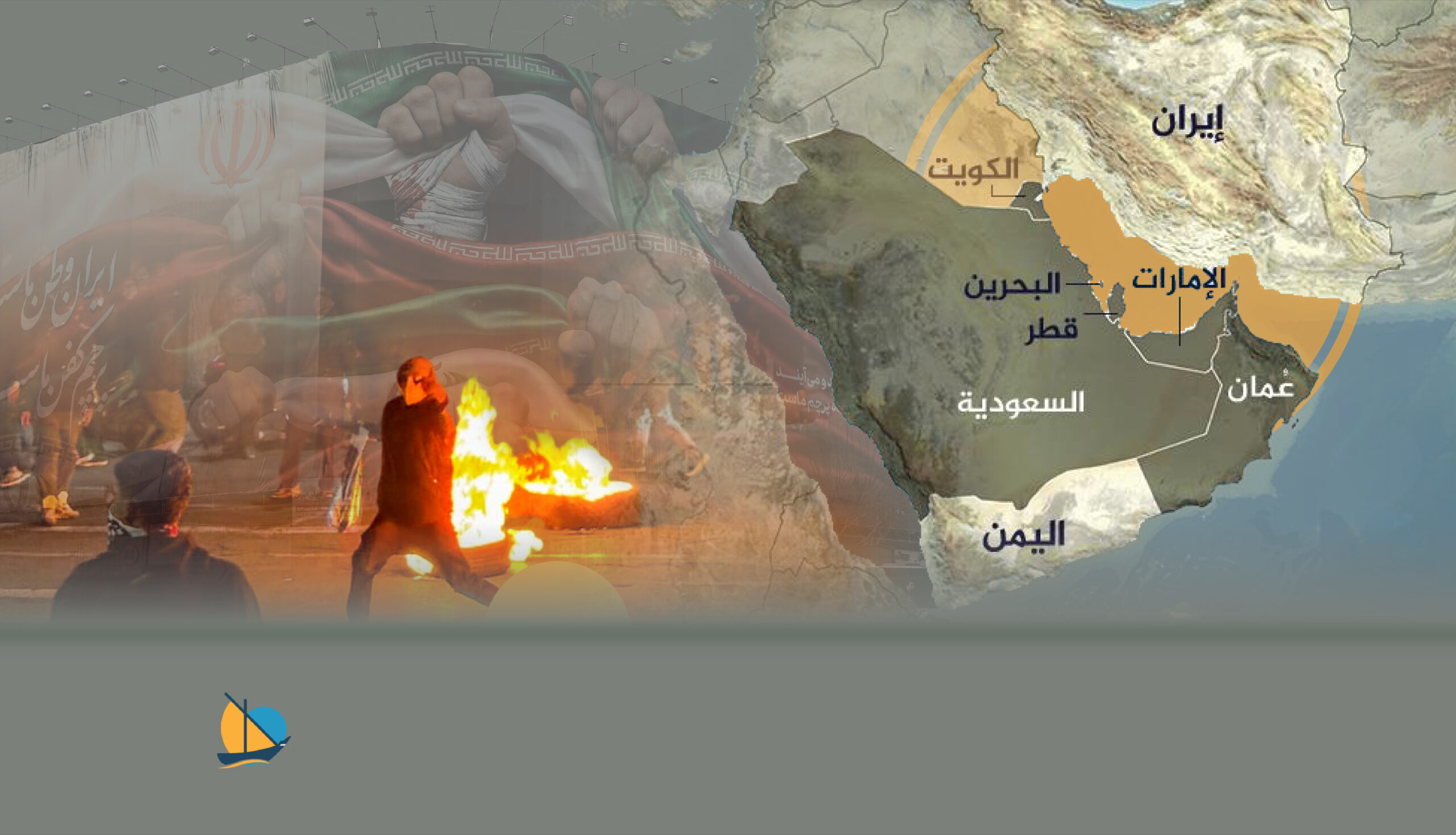
Iran’s Gulf-facing neighborhood now emerges as a decisive variable in any equation for exiting this impasse. Rapprochement with the Arab Gulf states—particularly Saudi Arabia—represents a rare political and economic opportunity for Tehran.
Reconciliation with Gulf countries could provide Iran with a shortcut out of its political and economic isolation. By leveraging the Gulf states’ close relationships with Washington, Iran could open tangible pathways previously closed to it. Beyond diplomacy, such engagement could unlock channels for investment and trade, ultimately reintegrating Iran into its natural regional environment rather than binding it to distant and convoluted circumvention routes that have already demonstrated their limitations.
A recent analysis by the International Crisis Group notes that reducing Iran’s regional tensions—including with the Gulf states—is no less important than any nuclear negotiation. It stresses that “the cost of sustained confrontation is draining the resources of the Iranian state.”
This trajectory does not require Iran to alter its political system. Rather, it points to the necessity of grasping the complexities of the current regional moment and repositioning accordingly. That shift can only occur through a transition from the logic of open-ended conflict to the logic of cost management—and, by extension, from Iran’s excessive investment in external instruments of influence toward a strategic investment in internal stability.
Society and Exhausted Patience
What is unfolding in Iran today is a gradual unravelling of the social contract between the state and society—a contract built on an exchange of sacrifice and patience for security and a minimum threshold of stability. That bargain has lost its meaning as its material foundations have eroded and as the state has failed to offer a credible economic or social horizon.
The notion of “revolutionary patience” has collapsed as a usable political asset. Patience is no longer interpreted as a marker of ideological commitment or collective consciousness, but as an imposed condition of exhaustion without return. As the gap widens between state promises and the harsh realities of daily life, social frustration has shifted from a latent condition to an active pressure point, undermining the very foundations of stability and turning any further delay in redefining state–society relations into a political gamble with open-ended consequences.
Stability rooted primarily in security control does not resolve Iran’s problems; it brings them closer to eruption at any moment, without requiring any external intervention.
Tehran may be able to endure another year under sanctions. The real question is whether Iran still possesses the luxury of time.
It is increasingly clear that the slow pace of reform and change—long celebrated by the state and its supporters as a deliberate choice—risks becoming a lethal burden at a moment when economic pressures intersect with rapid regional transformations. Iran now stands at a crossroads: between a smart repositioning that reconnects the domestic and external spheres, and the continued management of a crisis that steadily hollows out the state from within.