

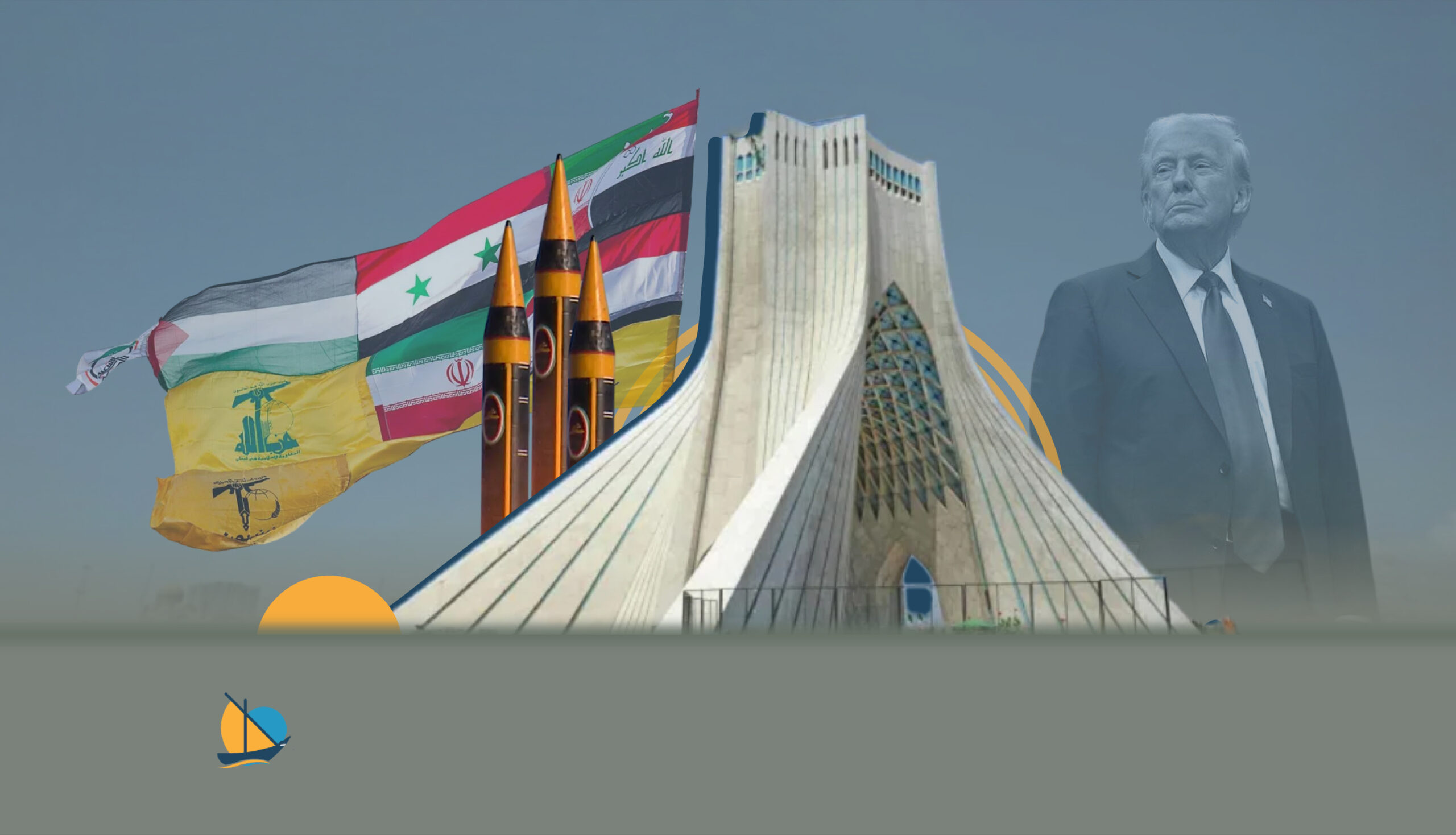
After two consecutive years of shocks across the Middle East, Iran now presents itself as a besieged state relying on tactical defense and calibrated patience. Tehran is reorganizing its domestic and regional cards after a series of tremors that cut into its capabilities and influence. The war that erupted in Gaza two years ago, followed by reciprocal exchanges between Israel and Iran in June, exposed Tehran’s limited capacity to turn its regional allies into instruments of decisive change on the ground. In parallel, the United States re-emerged as the pivotal actor capable of regulating the region’s deadlock and imposing political alternatives on the parties to the conflict. The Gaza truce and prisoner exchange announced under the auspices of U.S. President Donald Trump confirmed this reality and reflected Washington’s ability to shape outcomes. This has necessarily reset Iran’s strategic priorities.
Since the 1979 revolution, support for the Palestinian cause, and for Hamas in particular, has been a fixed pillar of Iranian foreign policy. Yasser Arafat’s visit to Tehran a week after the revolution’s success, and the embedding of Palestinian symbolism in Revolutionary Guard slogans and national iconography, consolidated this commitment. Despite shifting regional alignments, financial and military support for Palestinians continued, including an estimated one hundred million dollars annually according to the U.S. State Department. Iran consistently framed this support as advisory, preserving its political and ideological symbolism while managing risk with care.
The recent Gaza war demonstrated to Tehran that Hamas, despite sustained backing, could not be steered to deliver strategic outcomes. In the end, Hamas accepted a comprehensive U.S. plan for de-escalation that included a ceasefire and prisoner exchanges, while maintaining deliberate ambiguity over the movement’s future and its arms to reassure its domestic base. For Iran’s leadership, this confirmed that any direct confrontation with Israel in the current phase is fraught with danger and that U.S. decision-making is the decisive factor in setting the opening and closing of any confrontation.
In Syria and Lebanon, strategic retrenchment is evident. Syria is no longer a reliable platform for securing military supply lines or tactical positioning for allied forces. Hezbollah’s ability to provide support and sustainment at earlier levels has eroded, shrinking Iran’s strategic depth in Lebanon.
In Iraq, long a vital outlet to blunt sanctions and secure financing and supply channels, allied networks now operate under strict surveillance measures that limit Tehran’s capacity to shape events directly. This contraction in strategic depth has coincided with heightened international pressure, making any overt intervention a high-risk proposition. Iran has been pushed to reprioritize between risk management and patient maneuvering.
The nuclear file is now one of Iran’s primary instruments of restraint. With the collapse of the nuclear deal and activation of the international snapback mechanism, Iran has formally returned under Chapter VII constraints, facing stringent economic sanctions and limits on its nuclear and missile programs, along with the legal possibility of military response under certain conditions. Strategically, Tehran has adopted a policy of calculated freeze, effectively pausing the nuclear program to avoid triggering direct Western or Israeli escalation, while preserving technical know-how and stockpiles as a future bargaining asset.
This freeze is not capitulation but a tactic to conserve gains, minimize losses, and buy time for domestic stabilization and long-term planning. Any move toward a nuclear threshold in the next three years will be subjected to exacting calculations, with crisis management geared toward limiting escalation to the lowest necessary level.
By contrast, the missile program remains a strategic pillar that is not up for reversal. Battlefield experience during the June flare-up demonstrated the real impact of Iran’s missiles and unmanned systems in reshaping adversary calculations and imposing tactical constraints on Israel. This reinforced the leadership’s decision to hold the missile program as a central deterrent, improving precision, range, and resistance to interception without sliding into an open nuclear race or a direct clash with major powers.
The missile portfolio has become Iran’s most valuable strategic card. It is the clearest guarantee of deterrent capacity and the preservation of an irreducible margin of regional influence, even as other files undergo temporary freezing.
Economically, U.S. and European sanctions have tightened restrictions on trade and finance across the board, including oil and banking networks, which has driven down revenues and intensified domestic pressures. In response, Iran’s leadership has pursued policies to shore up internal stability and ease social strain through limited support for social safety nets while safeguarding regime cohesion and institutional continuity. The emphasis is on preventing any domestic crisis from becoming a spark for external escalation or political disruption that could regenerate international pressure at an inopportune moment.
Over the next three years, that is, through the remainder of President Donald Trump’s current term, Iran is likely to maintain an organized freeze across multiple tracks.
First, it will freeze direct regional moves and curb overt intervention in arenas such as Syria, Lebanon, Gaza, and Iraq, relying instead on indirect influence through proxies or deniable channels.
Second, it will freeze escalatory steps in the nuclear program while maintaining stockpiles and technical capacity to preserve strategic leverage.
Third, it will reinforce missile deterrence by improving accuracy and range, while avoiding a slide into a full-scale confrontation.
In Gaza, Iran will continue indirect support for Palestinians and Hamas while preserving ideological and strategic dimensions, yet it will press allies to exercise restraint and to protect existing gains while reducing risk. In Syria, Tehran is expected to move toward normalization with the new governing order. In Lebanon, it will keep Hezbollah’s activity under restraint with a focus on internal stability and avoidance of major provocations. Iraq will remain a space for cautious political and economic influence management, with efforts to limit any potential clash with foreign forces or international actors.
Three principal scenarios are conceivable in this period. The baseline and most likely scenario is a balanced freeze across files, retention of missile deterrence, and internal management of the economic crisis. A second scenario involves limited escalation in response to any direct strike against sensitive capabilities, with a disciplined and narrowly tailored reply. A third, less likely and more dangerous scenario would stem from miscalculation triggered by domestic upheaval or external escalation, potentially prompting a larger response that would require crossing strategic guardrails the leadership is intent on preserving.
The bottom line is that Iran after these two years is neither a failed state nor a victor. It is a state protecting its gains and opting for the lowest-cost path that keeps a careful balance between internal and external risks. The regional implications of this posture will be felt across spheres of influence and among allies. The margin for maneuver by Iran’s partners will narrow, which will pressure factions such as Hamas and Hezbollah to avoid impulsive escalation. On the other side, moderate regional states may expand their economic and political roles in ways that shift maps of influence and political weight. The United States and its allies will remain the region’s gatekeepers, recasting the rules of the game in the Middle East for years to come, even as they recognize that any direct confrontation with Iran is inherently perilous.
This is not a moment of weakness or retreat, even if it appears so to many observers. It is a strategic pause that allows Iran to buy time, cut losses, study setbacks, and retain a wide set of future options while it resets its domestic and regional cards. The aim is readiness to engage whatever changes the landscape may produce. Iran remains a consequential actor, and the future scope of its role will hinge on what the coming months and years bring.