
Kuwait Between Suspension and Reform: Testing the State’s Commitment to Political Transition

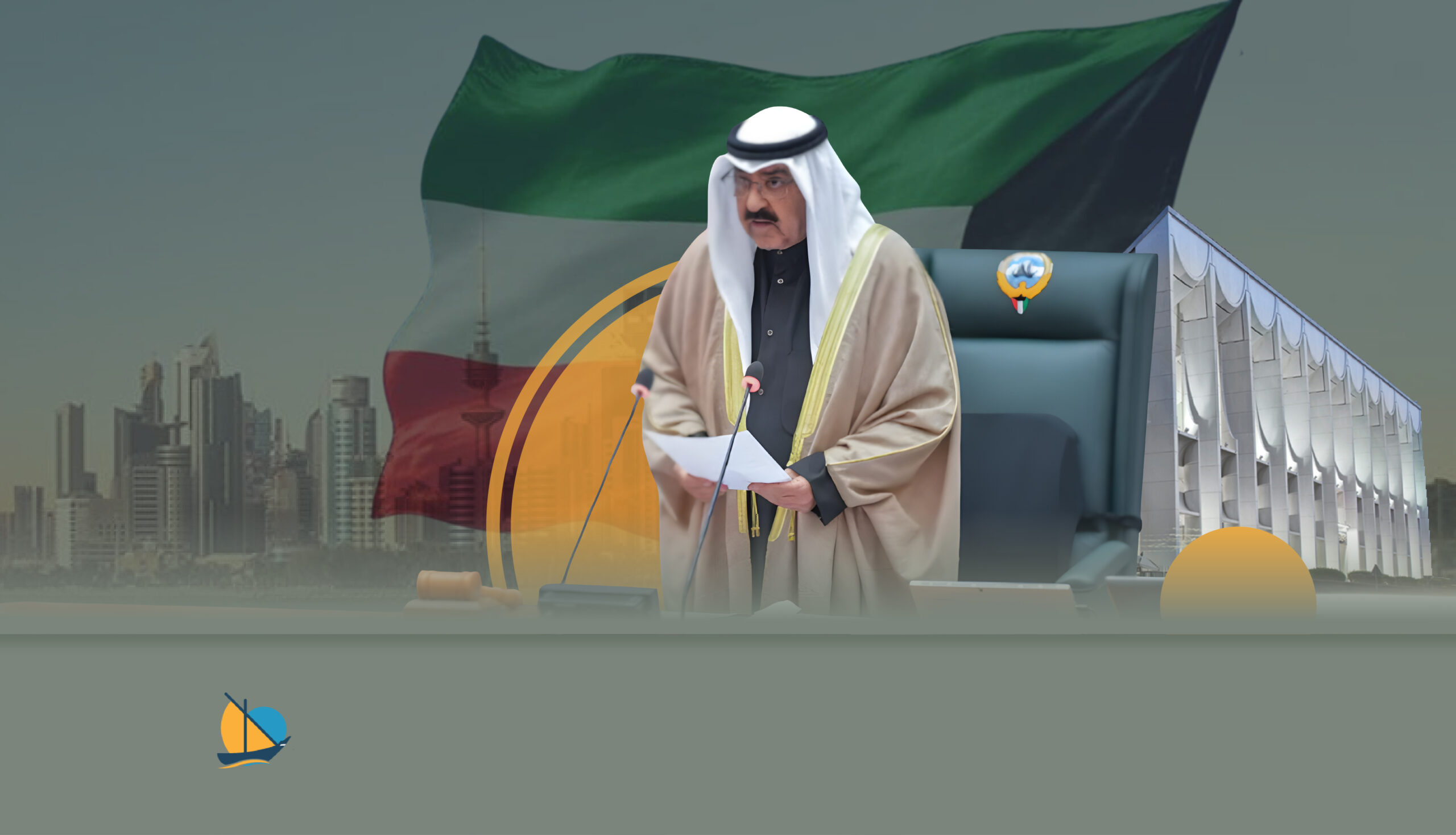
In May 2024, Kuwait witnessed a decisive turning point when the Emir of the country, Sheikh Mishal Al-Ahmad Al-Sabah, issued an Amiri order suspending certain articles of the constitution and dissolving the newly elected National Assembly for a period not exceeding four years, during which the Emir and the government would assume full legislative and executive authority.
The Emir justified his decision as necessary to “save the state” and protect the supreme national interest in light of a state of “political deadlock” and repeated conflict between the parliament and the government that disrupted the course of development. However, more than a year after this suspension, the picture remains unclear as to whether the state will adopt substantial reforms to some constitutional provisions.
This article reviews developments in the constitutional situation following the suspension decision and discusses the possible scenarios between the continuation of the suspension or moving towards a reformist path, with a focus on the expected areas of constitutional amendment.
Since the adoption of the 1962 Constitution and the first election of members of the National Assembly in 1963, the Assembly has enjoyed the right to legislate, question ministers, and participate in confirming the Crown Prince. This has made Kuwait a democratic exception in a region dominated by absolute monarchies. This parliamentary experience has not always been smooth and stable. The country suffered for decades from repeated cycles of crises: the dissolution of the Assembly, followed by new elections, and continued disagreements between opposition MPs and appointed governments. Since 2006, Kuwait has witnessed about ten parliamentary elections, and only one Assembly completed its constitutional term. This has led to a near consensus between the ruling family and the majority of Kuwaitis on the existence of a structural flaw in the system.
In the midst of this tense context, the decision of the Emir to suspend parliamentary life came as a radical step. However, it is not a historical precedent, as the rulers of Kuwait had previously resorted to a similar measure twice before, in 1976 and again in 1986. What is new this time is that the suspension came due to a severe internal political crisis that reached its peak at the beginning of 2024.
The Emir of Kuwait explained in his suspension speech that the measure is temporary and that he does not intend to abolish Kuwaiti democracy entirely. He affirmed that this period will be used to “review the democratic process” and correct its course to achieve more stable governance and more effective development. At that time, a plan was announced to form a committee of experts tasked with proposing constitutional amendments within six months, to be presented later within a period not exceeding four years to a public referendum or a newly elected National Assembly for approval.
These promises initially eased the fears of some citizens, as they were considered a guarantee that the suspension would not be prolonged indefinitely. The Emir also moved quickly to arrange internal affairs by appointing a new technocratic government in May 2024 and selecting Sheikh Sabah Al-Khaled Al-Sabah (the former Prime Minister) as Crown Prince in June of the same year. However, these steps, in the view of critics of the authorities, are merely procedural measures that do not address the essential questions on the table: what comes after the suspension of the constitution? Will we actually witness serious political reforms, or is this a prelude to Kuwait transforming into a system of governance similar to its Gulf neighbors?
At the internal level, despite relative calm, the general public sentiment remains a mixture of anticipation and caution. Despite the absence of large-scale protests, opinion polls indicate that the National Assembly is still seen by the majority of Kuwaitis as necessary to achieve balance and monitor government performance. Kuwaitis also believe that democracy, despite its problems, remains the best political system to rely on.
Regionally, the decision was welcomed and supported by the Gulf states, which quickly initiated communications and visits between the country’s leaders and the Emir of Kuwait. It goes without saying that the Gulf states had viewed the Kuwaiti democratic model with reservation. Reports indicate that Kuwait’s decision also contributed to slowing the emerging democratic path in Qatar, which indicates a general Gulf trend toward reducing spaces for political participation in favor of a narrative of supporting stability and maintaining security and economic development.
Internationally, reactions were lukewarm, as the United States and Western countries were content with moderate diplomatic positions. This reflects their current priorities in dealing with other regional files such as the war in Gaza and tensions with Iran, which made developments in Kuwait pass without major international pressure or criticism. At the same time, it does not appear that the established Western democracies, led by the United States, are still interested in the issue of supporting democracy, whether in the Gulf region or in any other region.
In any case, three possible scenarios stand out today as potential outcomes for the political scene in Kuwait. The first, which is the negative scenario, is the extension of the suspension and its transformation into a permanent reality by disabling the National Assembly and completely ending its political role, similar to what is in place in the rest of the Gulf countries. This scenario is supported by the silence of the executive authority and the ambiguity surrounding the fate of the committee of experts tasked with presenting the constitutional amendments, which has not submitted its proposals despite more than a year having passed.
The second scenario is the path of genuine reform, where parliamentary life returns after deep constitutional amendments that include a balanced redistribution of powers between the legislative and executive authorities and amending parliamentary oversight mechanisms to ensure government stability. This also includes removing the National Assembly’s role in confirming the Crown Prince and making the appointment an exclusive and direct prerogative of the Emir of the country. It also includes reforming the electoral law, which may legislate restricting voting to Kuwaitis who hold founding citizenship. This is consistent with recent measures related to reviewing Kuwaiti citizenship and the revocation and withdrawal of nationality from tens of thousands of Kuwaitis on the grounds of violating legal provisions.
The third scenario, which is the least ambitious, is a return to the previous situation as it was before the suspension, without making any fundamental amendments to the constitution, due to internal and external pressures. This leads to the continuation of the political conflict and the internal crisis without a radical solution. This is exactly what happened during the first and second suspensions of the constitution.
In conclusion, Kuwait today stands at a critical political crossroads where the upcoming decisions will determine the nature of its political system for decades to come. While attention is focused, both internally and externally, on the next steps, the question remains about how serious the state is in fulfilling its promises of reform and addressing the internal political crisis, or whether it will move toward a more stable but less democratic authoritarian model. At the same time, questions are growing about the nature of the obstacles that still exist before the government with regard to the economic development file, which remains stagnant, as it has long been. This highlights the persistence of structural challenges that the authorities have not yet addressed.